Availability:
What's New
We boast Australia's fastest growing online selection of wines, spirits and liqueurs added to weekly. If you can't find what you're looking for, call us on 1800 069 295 and we'll try to track it down.
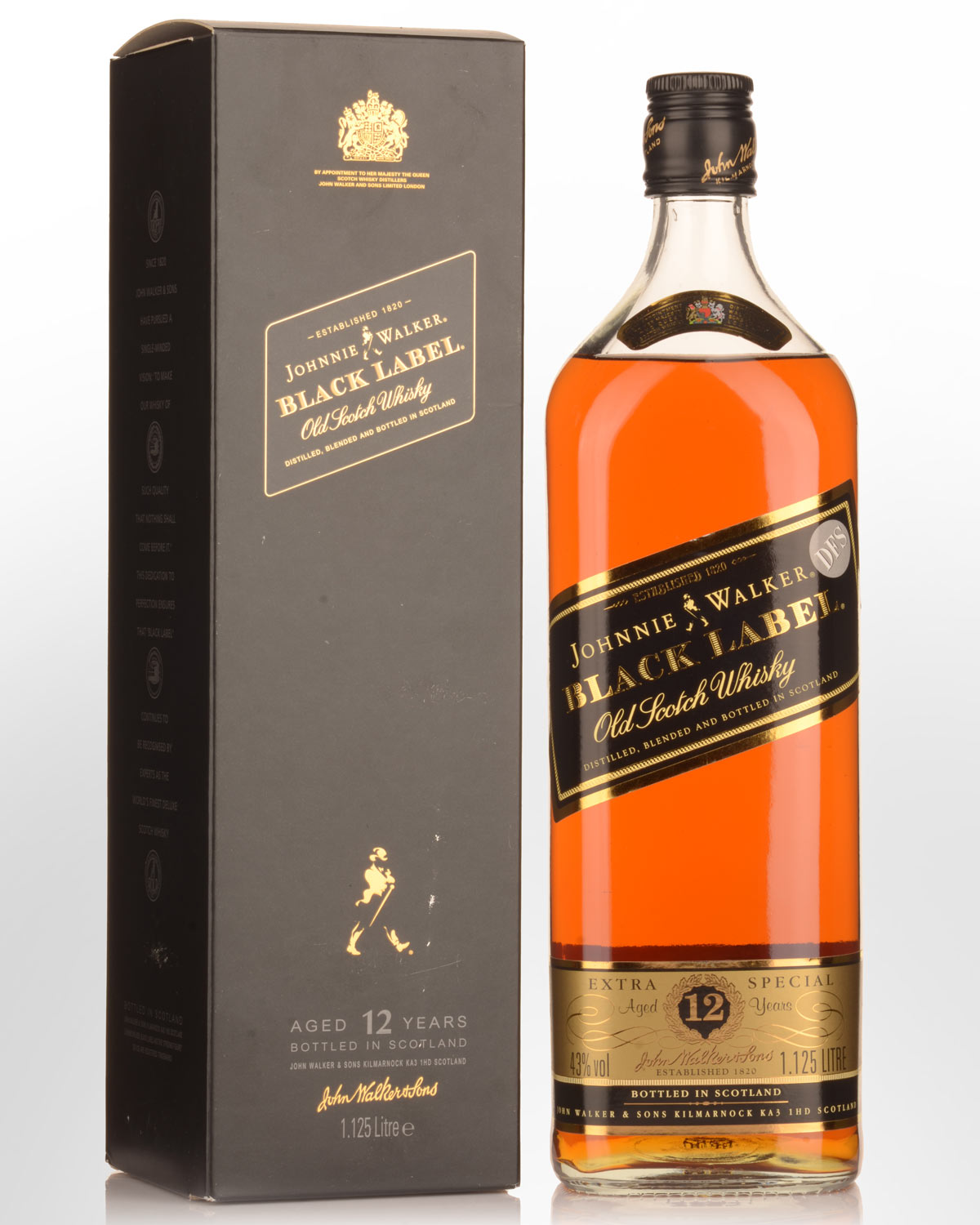
![Johnnie Walker Black Label 12 Year Old Blended Scotch Whisky (1125ml)]() Johnnie Walker Black Label 12 Year Old Blended Scotch Whisky (1125ml)SCOTLAND$199. 00Bottle$2388.00 DozenABV: 43%
Johnnie Walker Black Label 12 Year Old Blended Scotch Whisky (1125ml)SCOTLAND$199. 00Bottle$2388.00 DozenABV: 43%Note: Product has come from a private collection and as such has some minor scuffing/scratches/handling marks. Actual product not pictured.
A collectable Johnnie Walker Black in an extra large format that was originally offered via duty free, probably during the 1990s. Bottled at 43% Alc./Vol.![Overeem Distillery Port Cask Matured Single Malt Whisky (700ml) - 43%]()
- 90
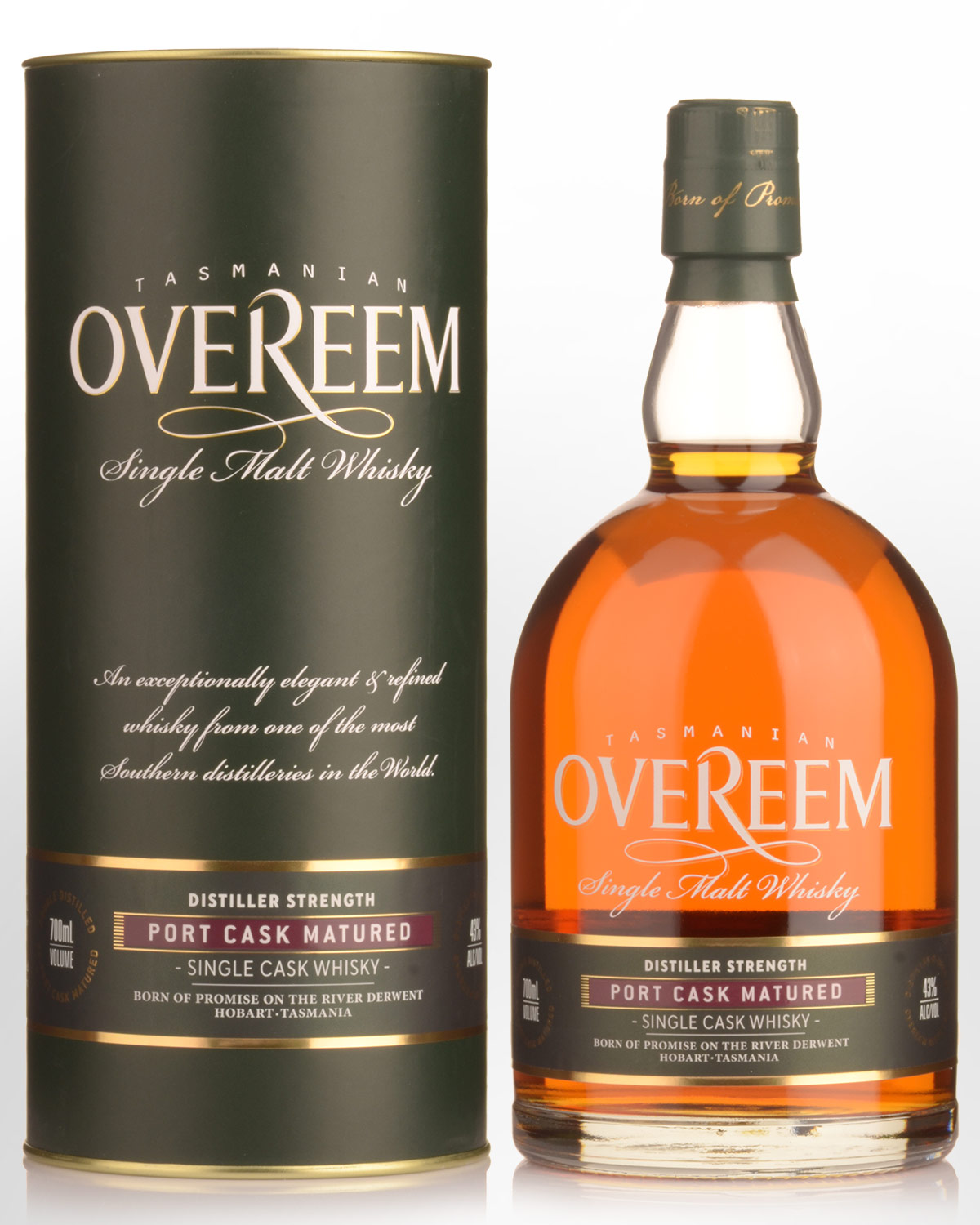
Overeem Distillery Port Cask Matured Single Malt Whisky (700ml) - 43%Tasmania, AUSTRALIA$199. 99Bottle$2399.88 DozenABV: 43%Unlike many Scottish equivalents, the port cask here takes back seat to the malt, though not without adding hints of dried red berries, Turkish Delight and fruit'n'nut chocolate - especially at the finish. That chocolatey overlay and near perfectly rounded delivery combine with low key spices and a casual, straightforward nature making this the affable every-day-drinker in the Overeem stable. 43% Alc.Vol.
First tasted 2012... Clean, moderately intense aromatics offer nuances of fruit chocolate, raisins and Turkish delight meshed with sweet malt. The palate is sweet and delicately spicy at first. Mid palate is light to medium bodied revealing hints of dried fruits followed by crisp, drying malt to finish. Aftertaste is subtle, sweet raisin toast-like, followed by a whisper of Turkish delight. Lingers with surprising length. 43% Alc/Vol.
![156161255_1.jpg]()
- 93
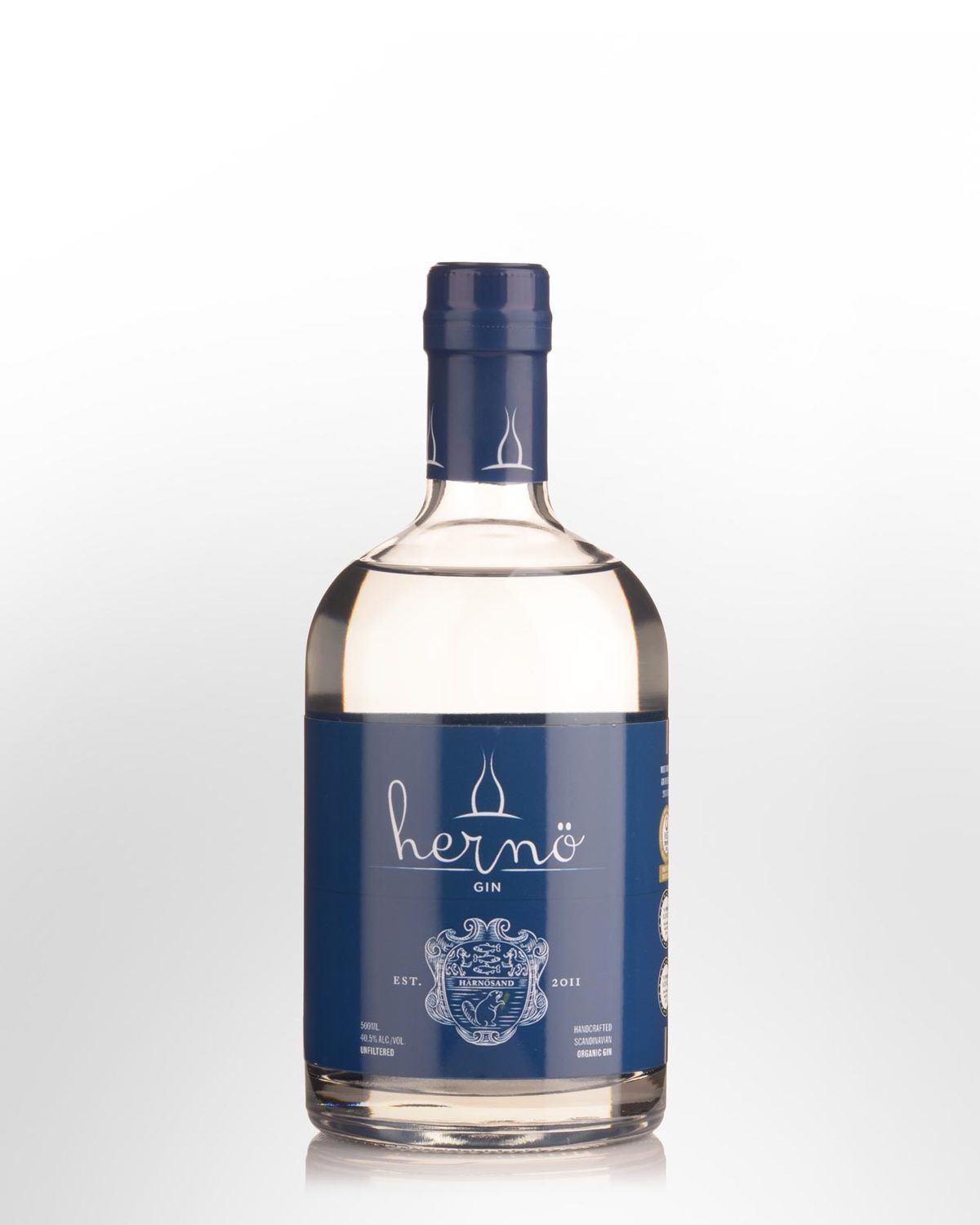
Herno Gin (500ml)SWEDEN$79. 99Bottle$959.88 DozenABV: 40.5%Launched in December 2012, Herno Gin was the most awarded gin at The Gin Masters 2013, which was arranged in London in the end of June 2013. It's an event that has fast become one of the most respected and high profile trade competitions in the industry, attracting many entries from leading brands all over the world. This year 49 gins participated.It all started in 1999. Jon Hillgren went to London together with a few friends to start working as bartenders. He discovered gin. During the years that followed the discovery evolved in to an interest in gin crafting. After tasting about one hundred gins, academic studies and subsequent visits to distilleries around the world, Jon finally founded Herno Distillery in 2011.
Situated in the village of Dala just outside the City of Härnösand in Ångermanland, Sweden, it is the country's first dedicated gin distillery and the world's northernmost. Production employs only organic ingredients and none of the gins are chill filtered.
Botanicals include juniper berries from Hungary, Coriander seeds from Bulgaria, hand peeled lemon, Lingon berries from Sweden, Meadowsweet from the United Kingdom, Black Pepper from India, Cassia from Indonesia and fresh Vanilla from Madagascar. The gin is hand bottled with each bottle marked with a batch and bottle number. Tasting note: [Batch 199 tasted] Clear. Leaps from the glass with piney juniper, dried coriander and peppercorn aromas over sweeter, citrus base notes. Very pure with fine-tuned juniper / cool-mint freshness followed by a vibrant, delicately tingling, lemon mousse, white pepper and dried herbal finish. Entry level ABV but no lack of flavour. 40.5% Alc./Vol.![1004518_1.jpg]() Skyy Vodka (700ml)San Francisco, UNITED STATES$64. 99Bottle$779.88 DozenABV: 37.5%
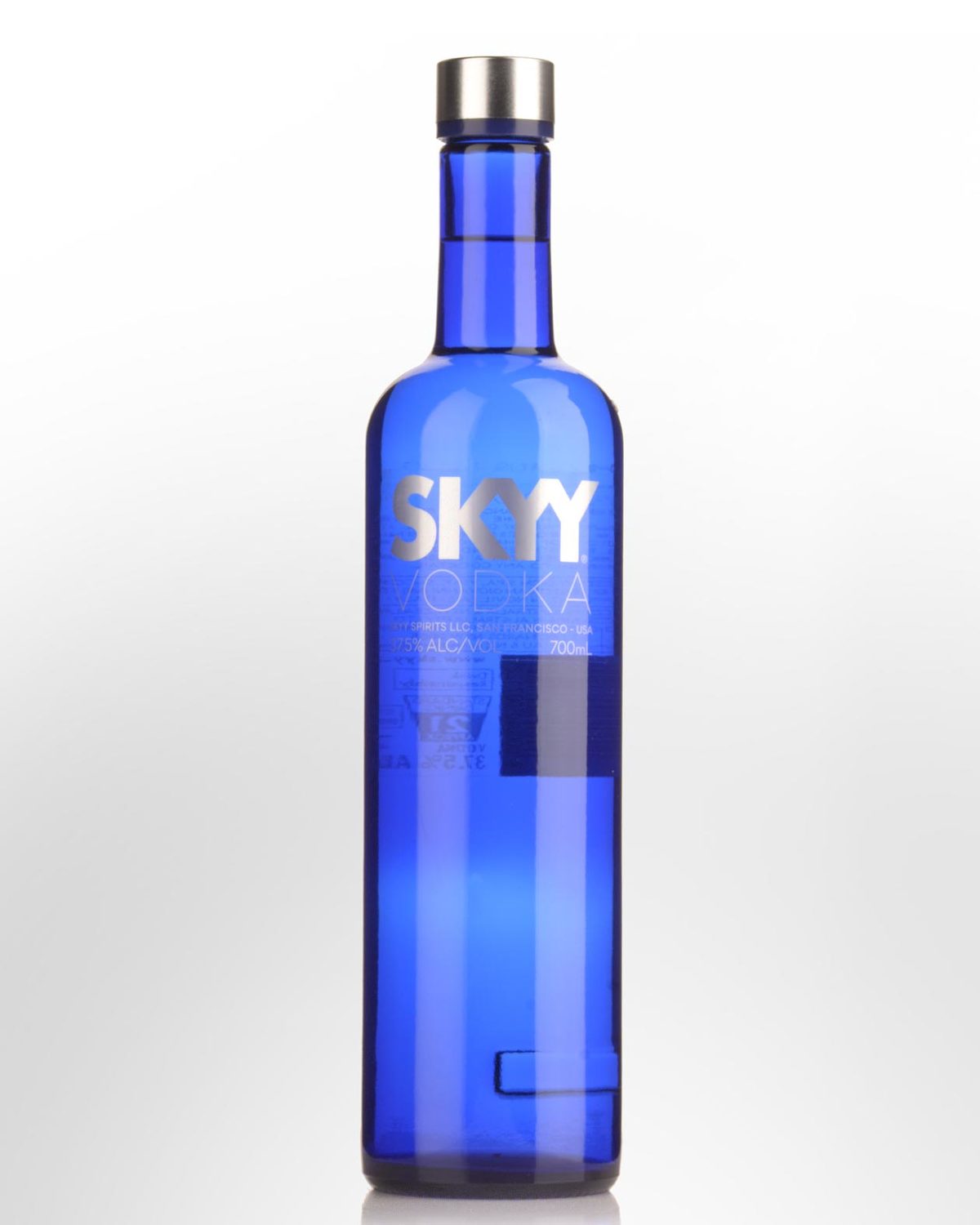
Skyy Vodka (700ml)San Francisco, UNITED STATES$64. 99Bottle$779.88 DozenABV: 37.5%To produce Skyy Vodka, grain from the American Midwest is mashed with purified water that has been treated in a reverse osmosis process to remove impurities. The vodka is then distilled four times, through a four column distillation and three step filtration system to create a very clean, neutral spirit. Recommended for sheer neutrality.
Other reviews... The grain takes a backseat in the early sniffing stages as bittersweet bean- and kernel-like scents dominate; later whiffs merely confirm the intense bean/cocoa quality. Palate entry mirrors the bouquet to a tee; at midpalate, the kernel-like intensity turns smooth and viscous on the tongue. Ends bittersweet and oily. 85-89 points - www.wineenthusiast.com
![6639311_1.jpg]()
- 92
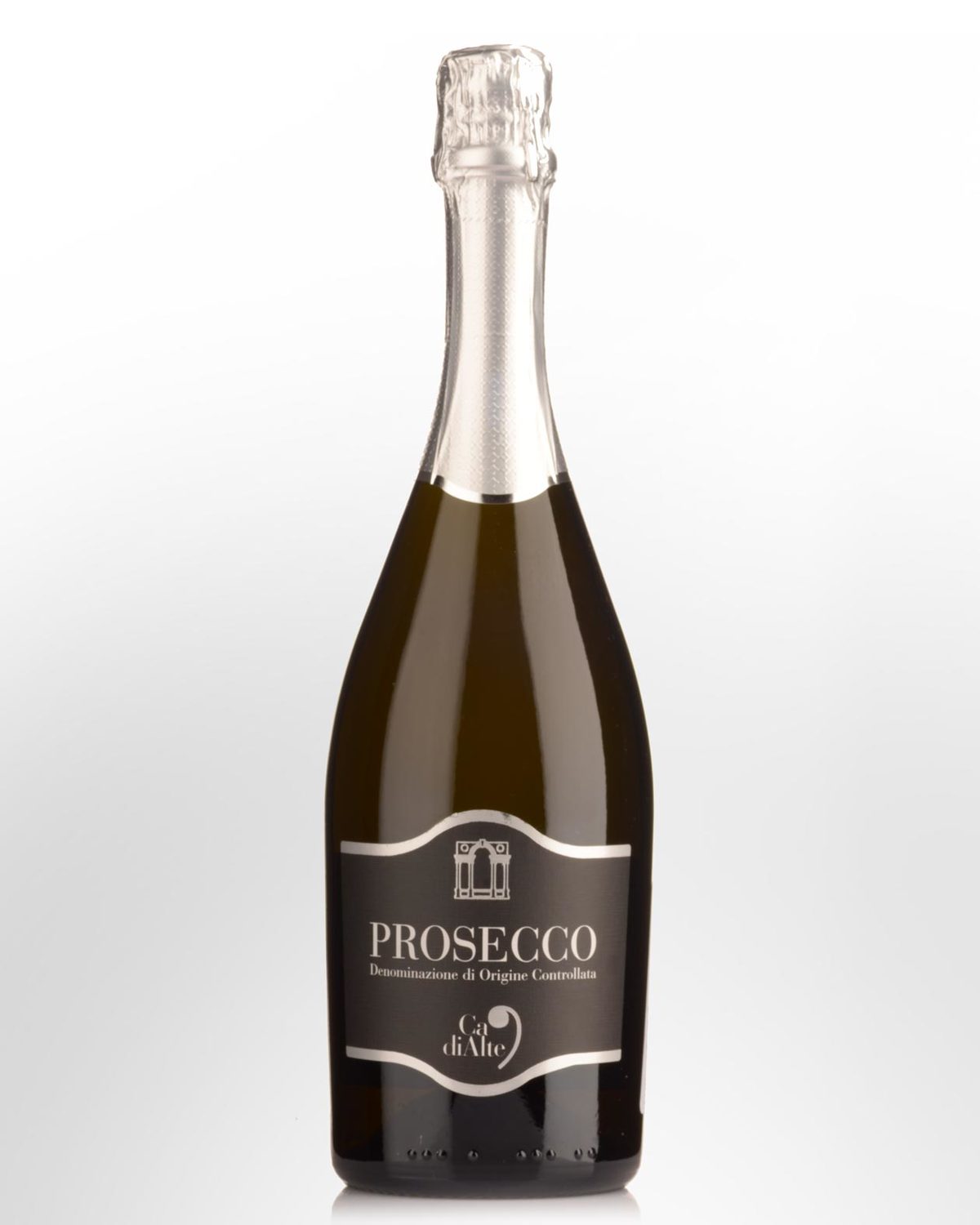
Ca di Alte ProseccoVeneto, ITALY$21. 99Bottle$263.88 DozenCellar: Drink now (2017)ABV: 11.5%Closure: Diam CorkFrothy white mousse showing good hold. Very pale straw coloured base wine threaded by a very fine and steady stream of tiny bubbles. Fresh ripe red apple and pear aromas emanate from the glass followed by hints of lemon sherbet and a subtle baked note. Light and airy as well as quite fruity, flavours of ripe pears and red apples are to the fore with a background of subtle lemon sherbet. Dry refreshing finish with crisp acidity and an aftertaste of ripe pears, baked apples and subtle lemon sherbet.
Drink now.
Alc. 11.5%![1028666_1.jpg]() Mount Gay Eclipse Rum (700ml)St. Micheal, BARBADOS$64. 99Bottle$779.88 DozenABV: 37.5%
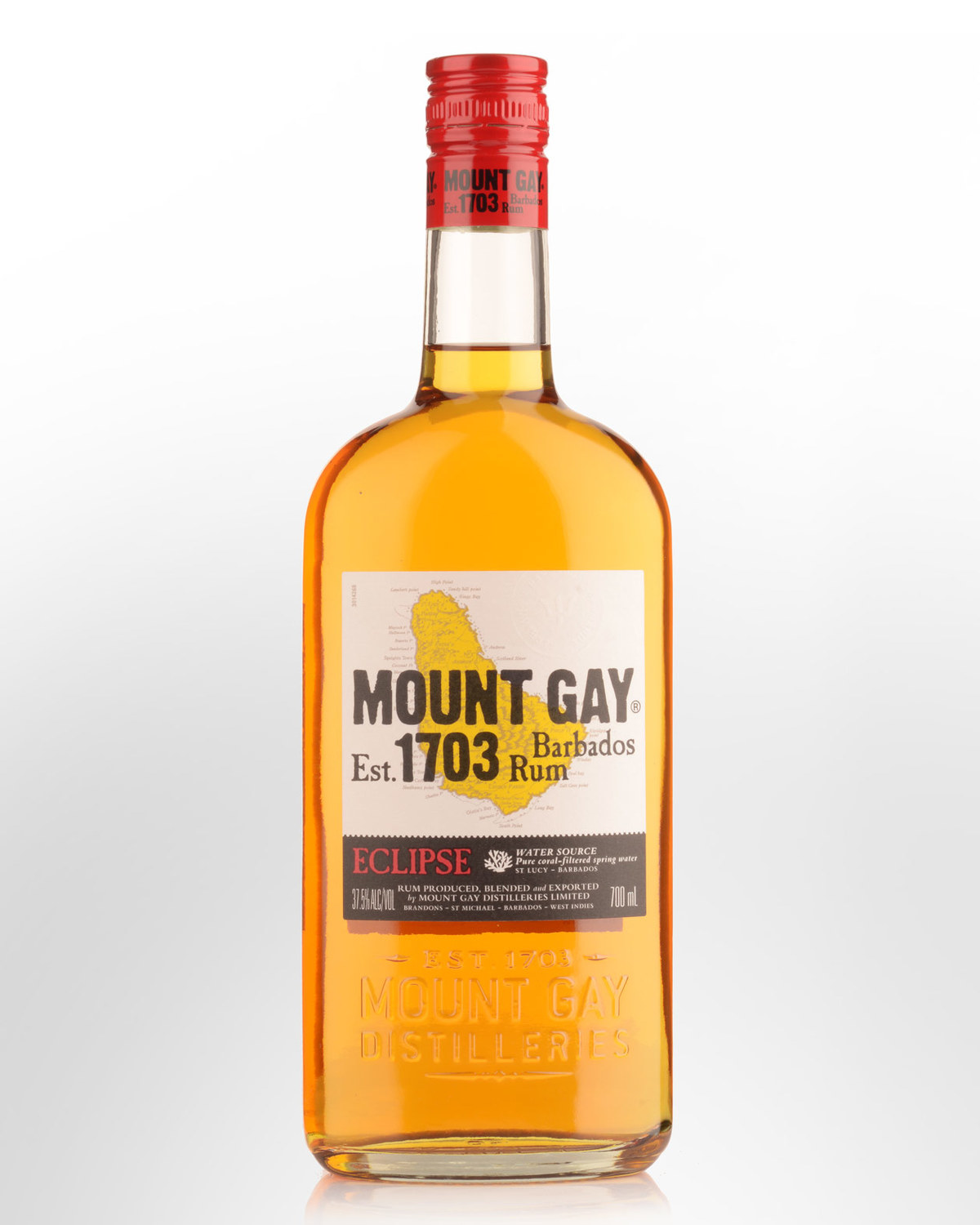
Mount Gay Eclipse Rum (700ml)St. Micheal, BARBADOS$64. 99Bottle$779.88 DozenABV: 37.5%Golden in colour with a restrained nose, followed by a medium bodied palate with a lovely dry finish, Mt.Gay comes from one of the oldest rum distilleries in the world. This spirit (of which the West Indies provide the most important supply of the finer quality rum) is either distilled direct (which is rare now) from fermented cane juice, or from molasses. which can be described as the residue of sugar syrup remaining after the cane juice has been boiled and the sugar crystals extracted. This process has continued at Mt. Gay for almost 300 years - handcrafted at the same location using the finest Barbados sugar cane and pure coral filtered spring water. Amongst sailors, the brand has earned its reputation as “the quintessential spirit of the seas.”
Tasting note: The soft sugary molasses smell in the first whiffs is mellow and gently sweet; aeration releases aromas of marshmallow, almond paste, and light toffee. The palate entry is slightly smoky and properly sweet; the midpalate phase highlights flavors of honey and vanilla extract. Finishes smooth, soft and eminently drinkable. Best Buy. 37.5% alc./vol. Rating: 85-89 - note sourced from www.wineenthusiast.comOther reviews...Golden amber color. Sweet buttery caramel, banana, and apple aromas. A round entry leads to lush, dry medium body with buttery caramel and mashed banana flavors. Long nut and peppery spice fade. A brilliant mixing rum.
International Review of Spirits Award: Silver Medal
RATED: 89 points (Highly Recommended) - note sourced from www.tastings.comHere is a standard “Jamaica Punch” recipe:
Start with plenty of Mt.Gay rum and ice;
fill with an equal amount of orange and pineapple juice,
combine a good measure of lime juice or lime cordial.
Add sliced fruit if you want to have something to eat while you drink.Click here to learn more about Rum.
![1021826_1.jpg]() Winesave Pro Argon Gas Wine Preserver$34. 99Bottle$419.88 DozenThe world's first, patented, hand-held canister containing 100% argon gas that's all-natural, high-quality & food-grade. Simply spray for one second into an opened bottle of wine and it creates a perfectly natural layer above your wine, preventing further oxidation from the air above. Winesave adapts what has long been a wine industry standard into a new, easy to use argon gas based home wine preservation system. It is a quick and easy application containing up to 150 effective doses. The primary element responsible for the deterioration of wine in an open bottle is oxygen. Oxygen interacts with ethanol (the alcohol in wine) and forms other less desirable compounds that alter and diminish the flavours of wine. In the world of wine preservation we have seen systems that attempt to remove someoxygen via suction or reduce most of the surface area of wine in contact with oxygen. Both are effective in part, but our third option, argon based Winesave, is a cut above.
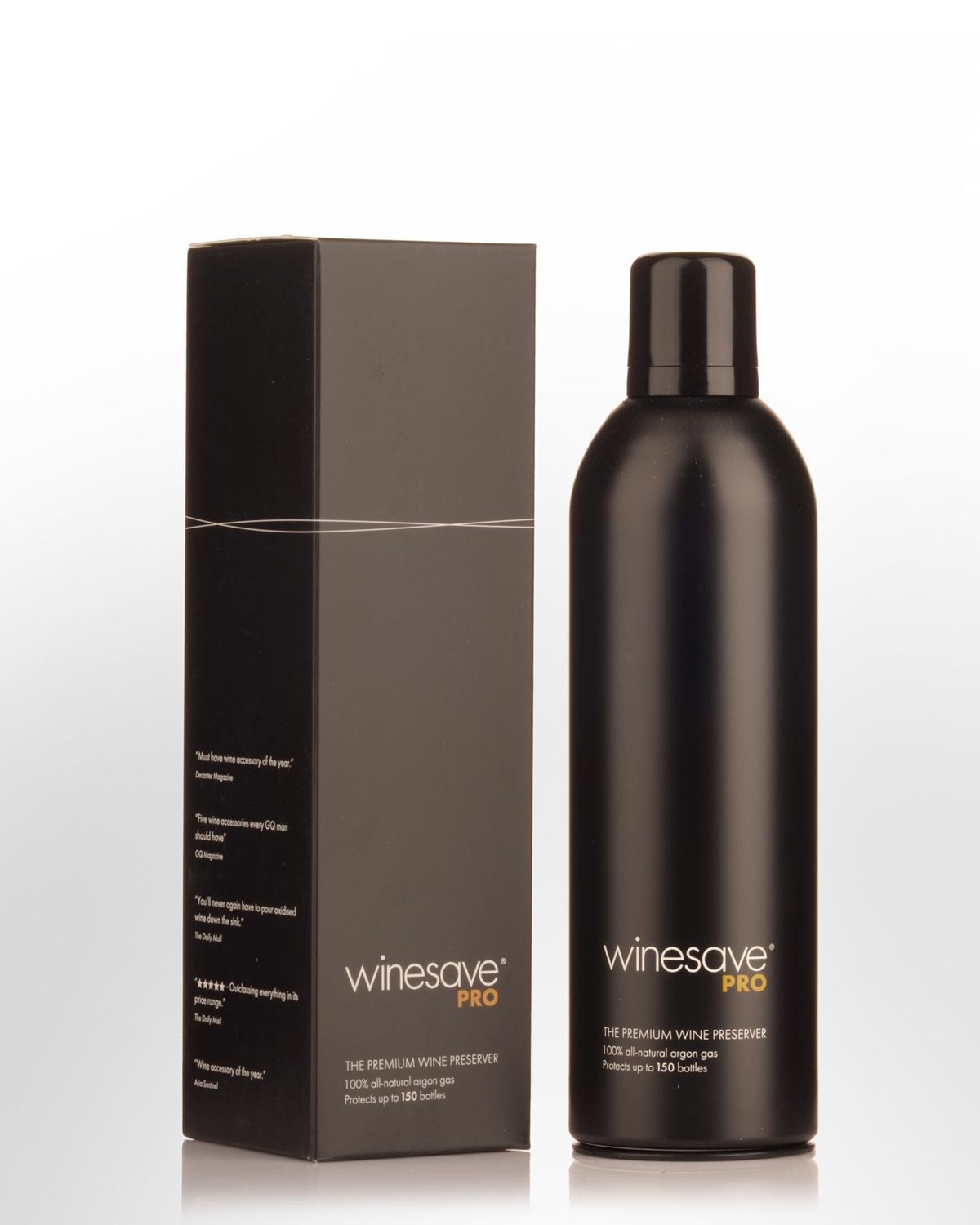
Winesave Pro Argon Gas Wine Preserver$34. 99Bottle$419.88 DozenThe world's first, patented, hand-held canister containing 100% argon gas that's all-natural, high-quality & food-grade. Simply spray for one second into an opened bottle of wine and it creates a perfectly natural layer above your wine, preventing further oxidation from the air above. Winesave adapts what has long been a wine industry standard into a new, easy to use argon gas based home wine preservation system. It is a quick and easy application containing up to 150 effective doses. The primary element responsible for the deterioration of wine in an open bottle is oxygen. Oxygen interacts with ethanol (the alcohol in wine) and forms other less desirable compounds that alter and diminish the flavours of wine. In the world of wine preservation we have seen systems that attempt to remove someoxygen via suction or reduce most of the surface area of wine in contact with oxygen. Both are effective in part, but our third option, argon based Winesave, is a cut above.
Argon (derived from the Greek rgon, meaning idle or inactive - a hint to its application in the preservation of wine) is odourless, colourless, (slightly) heavier than air and, as far as gasses go, somewhat lazy! Argon is what is known as an inert gas. As such it undergoes virtually no chemical reactions, unlike oxygen which is anything but idle or inactive. The ability to remove all the oxygen from a bottle makes Winesave uniquely suited to preserving older, more fragile wines or controlling the rate of development when decanting delicate vintages. Complete removal of oxygen also ensures a lengthier period of preservation is possible – “up to several weeks” according to the manufacturer, which is as good as forever for most drinkers. To use simply insert the Winesave applicator into your opened bottle, vent enough argon into the bottle to expel and replace all the oxygen in the head space, then replace the bottle’s closure. Your wine is safe from the active and destructive ways of oxygen until you next remove the seal from the bottle!
This product is not available for shipping to overseas destinations. ![1025748_1.jpg]()
- 92
Cocchi Vermouth di Torino Vermouth (750ml)Cocconato d'Asti, ITALY$59. 99Bottle$719.88 DozenABV: 16%Closure: CorkThe Bartender's choice for the finest Negronis, and more...
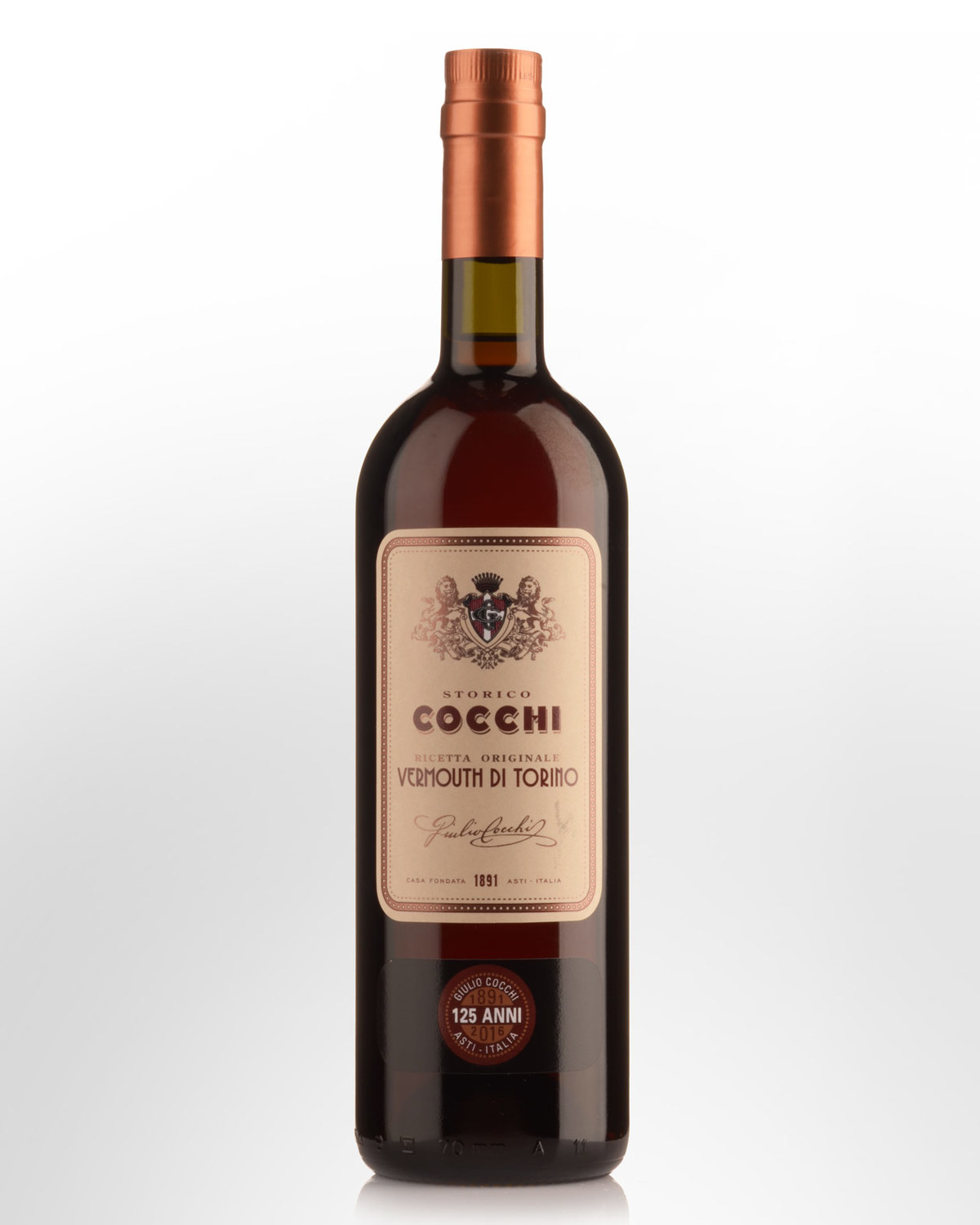
The House of Cocchi (pronounced co-key) is a Torino winery known for an array of still, sparkling and fortified wines. In 2011 as part of Cocchi's 120th birthday celebrations, they revived their house vermouth, originally produced in 1891, resulting in the first genuine Vermouth di Torino (protected designation of origin). Botanicals include bitter orange peel, cocoa, ginger, rhubarb, grand wormwood, cinchona bark, sandalwood, musk, myrrh, nutmeg, and caramelised sugar which brings both sweetness and contributes to its copper-sienna brown colour. The nose offers moderate scents of cocoa and spiced citrus (blood orange?) making for a nuanced jaffa-like profile with a distant menthol / Alpine herb freshness that keeps the sugars muted. This is not a vermouth of extremes, rather, a light to medium bodied, gently bitter style (a more delicate expression than the likes of Antica Formula, which some find too easily overpowers cocktails). Citrus peel, raisin and sweet spice flavours come with a hint of sarsaparilla, the whole seamlessly integrated and beautifully balanced, ending soft and bittersweet with suggestions of quinine, tangy citrus zest and cocoa. One of the main attractions to this formula is its sheer mixability. It melts into whisky in a magical way, and probably just about anything else you care to throw at it. Use whenever a red, rosso, sweet, or Italian vermouth is called for. Enjoy it in a Manhattan, Martinez or Negroni - and of course, the quality is more than good enough to drink straight or over ice. Try it as an aperitif paired with olives and hard cheeses. 16% Alc./Vol.
Other reviews... 5 stars - diffordsguide.com
Giulio Cocchi Storico Vermouth Di Torino is a bitter sweet vermouth, amber in the glass with burnt orange peel, dried stone fruit, cocoa, anise, warming, sweet and long on the palate. 89 points - nataliemaclean.com
![1028300_1.jpg]()
- Nicks Import
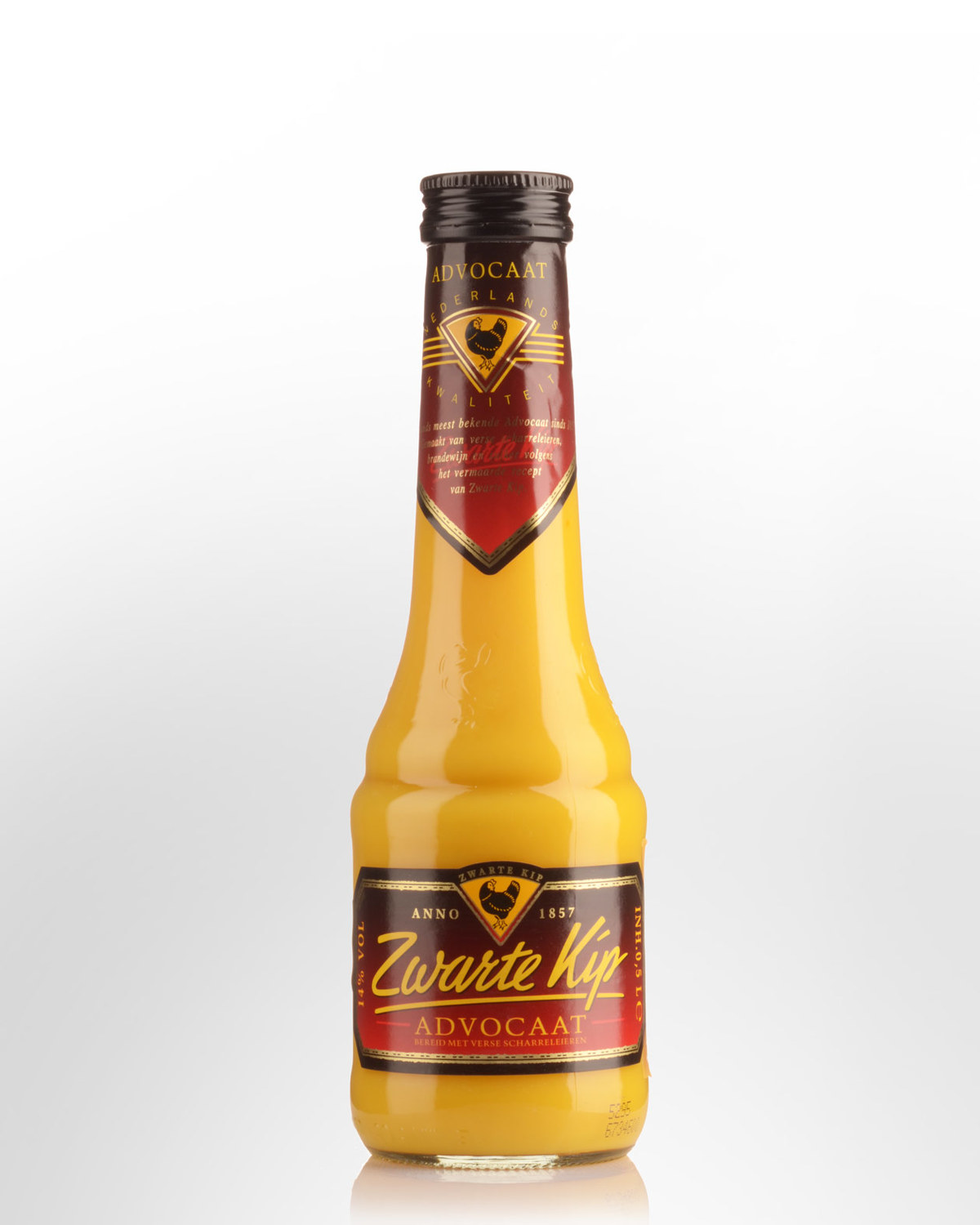
Zwarte Kip Advocaat (Advokaat) Liqueur (500ml)Amsterdam, NETHERLANDS$22. 99Bottle$275.88 DozenABV: 14%Closure: Screw CapAdvocaat is derived from the Dutch word "Advocatenborrel" which means - the drink of Advocates and Lawyers. Made from the yolks of new laid eggs, sugar and brandy.The colour is deep yellow, a result of the rich yolks used in its production. The texture is thick and creamy. Many recipes include small quantities of kirsch, vanilla and citrus peel extracts to enhance the flavour. Advocaat is known to be used as a topping on various desserts including pastries and ice-cream, it can also be enjoyed straight, or more popularly as a base for a range of excellent cocktails using hot or cold milk, soda or citrus juices.
Zwarte Kip (Black Chicken) Advocaat was established in 1857 and is easily recognized by its uniquely shaped bottle. The brand is now apart of the Lucas Bols portfolio based in the Netherlands.
No tasting notes available...
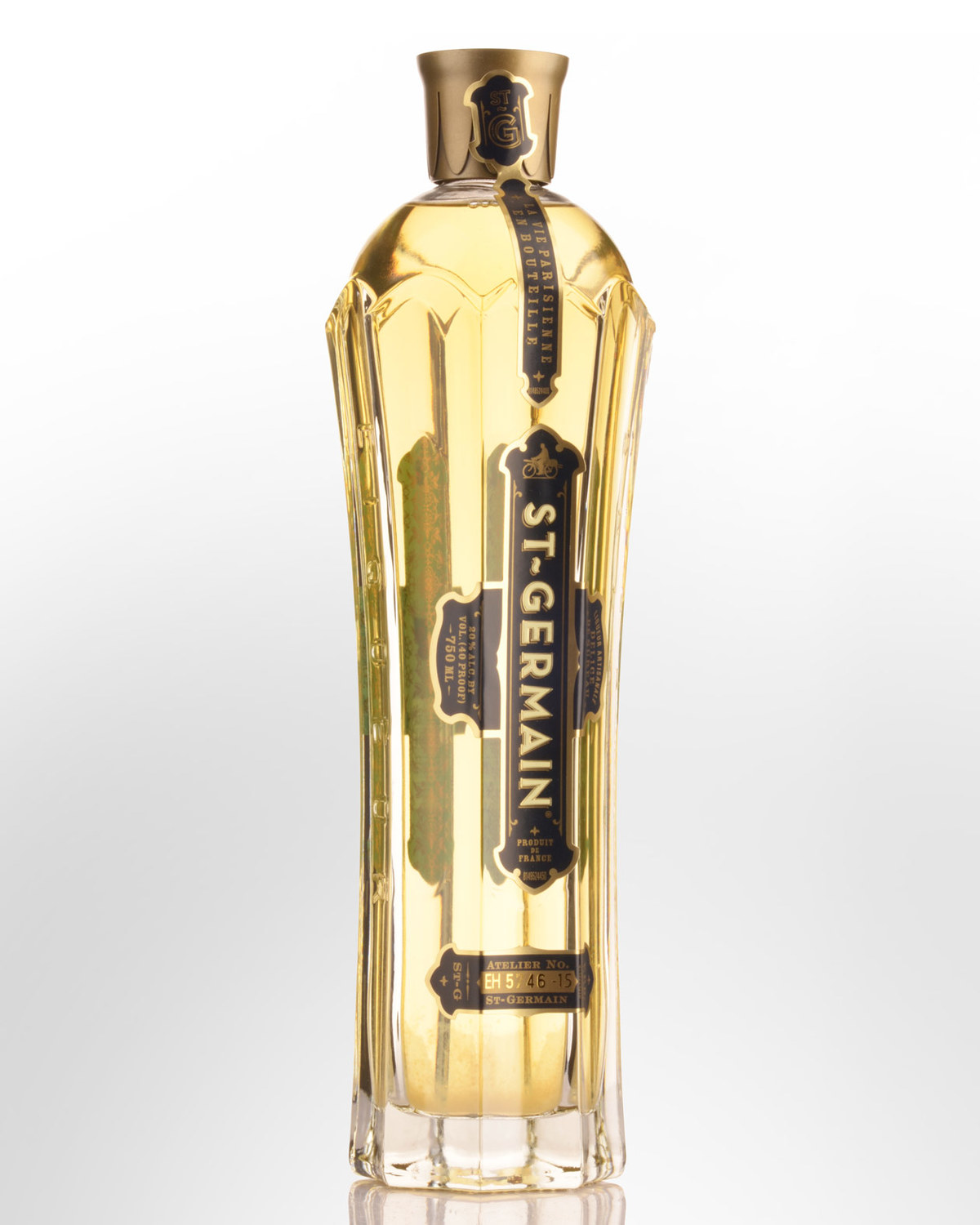
![1028364_1.jpg]() St. Germain Elderflower Artisanale Liqueur (750ml)Burgundy, FRANCE$69. 99Bottle$839.88 DozenABV: 20%
St. Germain Elderflower Artisanale Liqueur (750ml)Burgundy, FRANCE$69. 99Bottle$839.88 DozenABV: 20%This is the world's first liqueur made from 100% fresh, handpicked elderflowers from the foothills of the Alps. The flowers are delivered to the producer's on bicycles where they are distilled in small batches into a liqueur by French artisan company, St. Germain. The subtle yet complex flavour of this superb drink can be easily paired with a wide variety of spirits and in any number of wonderful cocktails. It's also recommended in a glass of champagne, in gin and tonic, or just with soda.
'A perfect liqueur. 96-100 points!'Tasting note: The seductive bouquet offers wonderfully floral, fruity, guava- and melon-like fragrances of elderflower, becoming richly pear- and quince-like following aeration time. The palate entry is soft and firm; the midpalate is integrated, harmonious and exquisitely balanced between alcohol level, sweetness, acidity and floral impact. A perfect liqueur. Rating: 96-100 points. - www.wineenthusiast.com
Other reviews... 'Over the last five years non-alcoholic elderflower cordial has grown to be one of the most popular ingredients in the British bartender’s palette of flavours. When compared to these established cordials St-Germain has a more floral elderflower flavour without the syrupy sweetness inherent in the sugar based cordials. I’ve used St-Germain in place of elderflower cordial in a host of established cocktails and found the resulting drinks far superior and complex to those made with the cordial.' - Simon Difford, Author, Difford’s Guides.

 Click here to learn more about Liqueurs
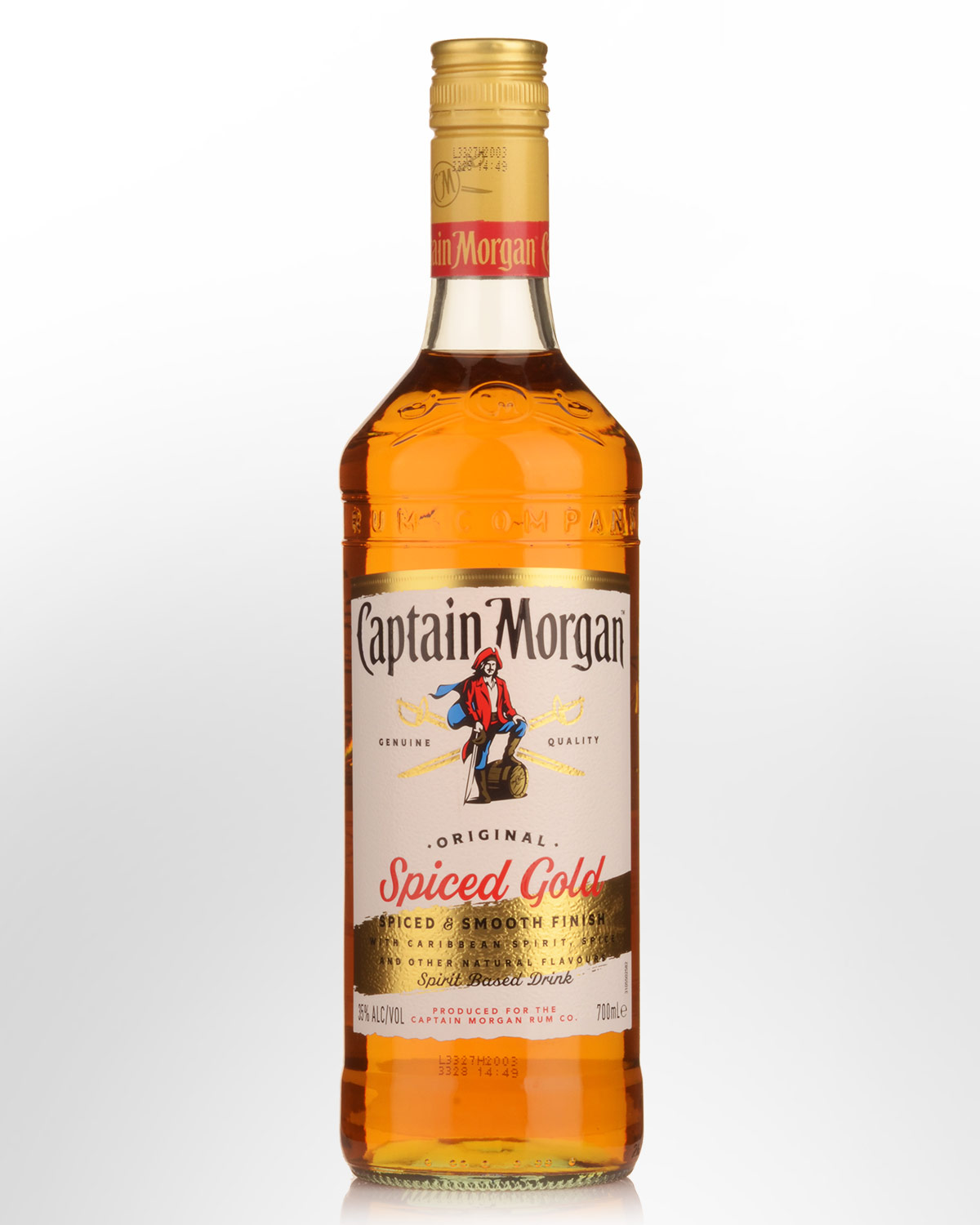
![Captain Morgan Original Spiced Gold Rum (700ml)]() Captain Morgan Original Spiced Gold Rum (700ml)JAMAICA$56. 99Bottle$683.88 DozenABV: 37.5%
Captain Morgan Original Spiced Gold Rum (700ml)JAMAICA$56. 99Bottle$683.88 DozenABV: 37.5%‘Spiced’ is the generic name given to any rum to which a local herb or spice has been added and allowed to impart its particular flavour. The most common additives for 'spiced' rums are Cinnamon, Rosemary, Aniseed and Pepper, but often vanilla will dominate contemporary styles. In their purest form, they're an acquired taste, however the best examples are deliciously different and make a flavoursome punch.
Other reviews... The no-nonsense bouquet opens up with marshmallow, light toffee and light honey. Early taste is sweet and molasses-centric, then at midpalate there’s a spiced honey flavor that gently guides you to the creamy, cake frosting finish. I liked this affable spiced rum when I first reviewed it 12 years ago and I still like it. Alc./Vol. 37.5% 85-89 points - wineenthusiast.com
![Camus Isle de Re Cognac (700ml)]()
- 91
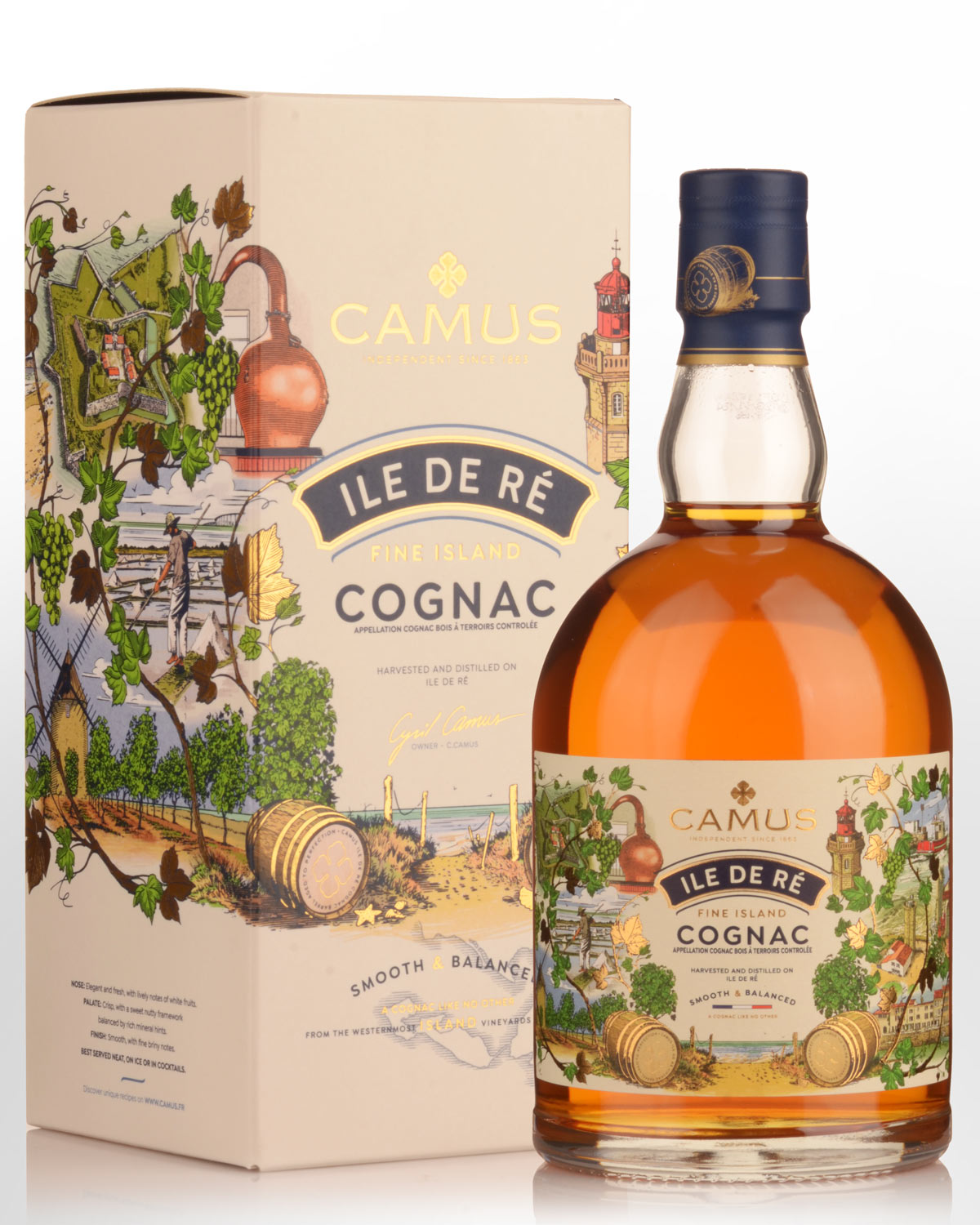
Camus Isle de Re Cognac (700ml)Cognac, FRANCE$119. 99Bottle$1439.88 DozenABV: 40%Camus have a precedent for marketing Cognac from 'less prestigious' appellations with some success (their Borderies XO is a favourite). This bottling from the Ile de Re is a new release, badged as "Fine Island Cognac". The island off the north west coast of Cognac is widely, and justly, considered to be one of France’s most beautiful areas. It is part of the Bois Ordinaires appellation (aka 'Bois Terroirs'), with free draining sandy soils and a maritime climate. Its vines give an early cognac mainly for local drinking, usually described as posessing "a characteristic local flavour" - which some have suggested is nothing more than a euphemism for mediocrity. Distilled on the lees to enhance the original flavors of the eaux-de-vie from which it's produced, this youthful Camus expression is then aged in an extremely damp cellar which is said to add roundness, using lightly toasted oak barrels that provide a delicate woody flavour.
The perfumed bouquet opens rich, luscious and fruity with dried fig, hints of poached pear and white pepper. Second pass is less lifted, emphasising a floral / honeyed note over lemon tart and hints of cigar box. Dryish and lean on entry, building into a softly spiced, semi-sweet mid palate with flavours of toasted almond, stewed pear and light honey. Concludes medium long with delicate prune and pepper in the aftertaste. 40% Alc./Vol
Other reviews... Bright amber color. Aromas and flavors of honey butter and spicy peach compote with a silky, light-to-medium body and a carefree finish with notes of spiced pears, pepper, blossoms, and caramelized nuts. A tasty, easy drinking cognac with a feminine appeal. International Review of Spirits Award: Silver Medal
88 points (Highly Recommended) - tastings.com![1508408_1.jpg]()
- 85
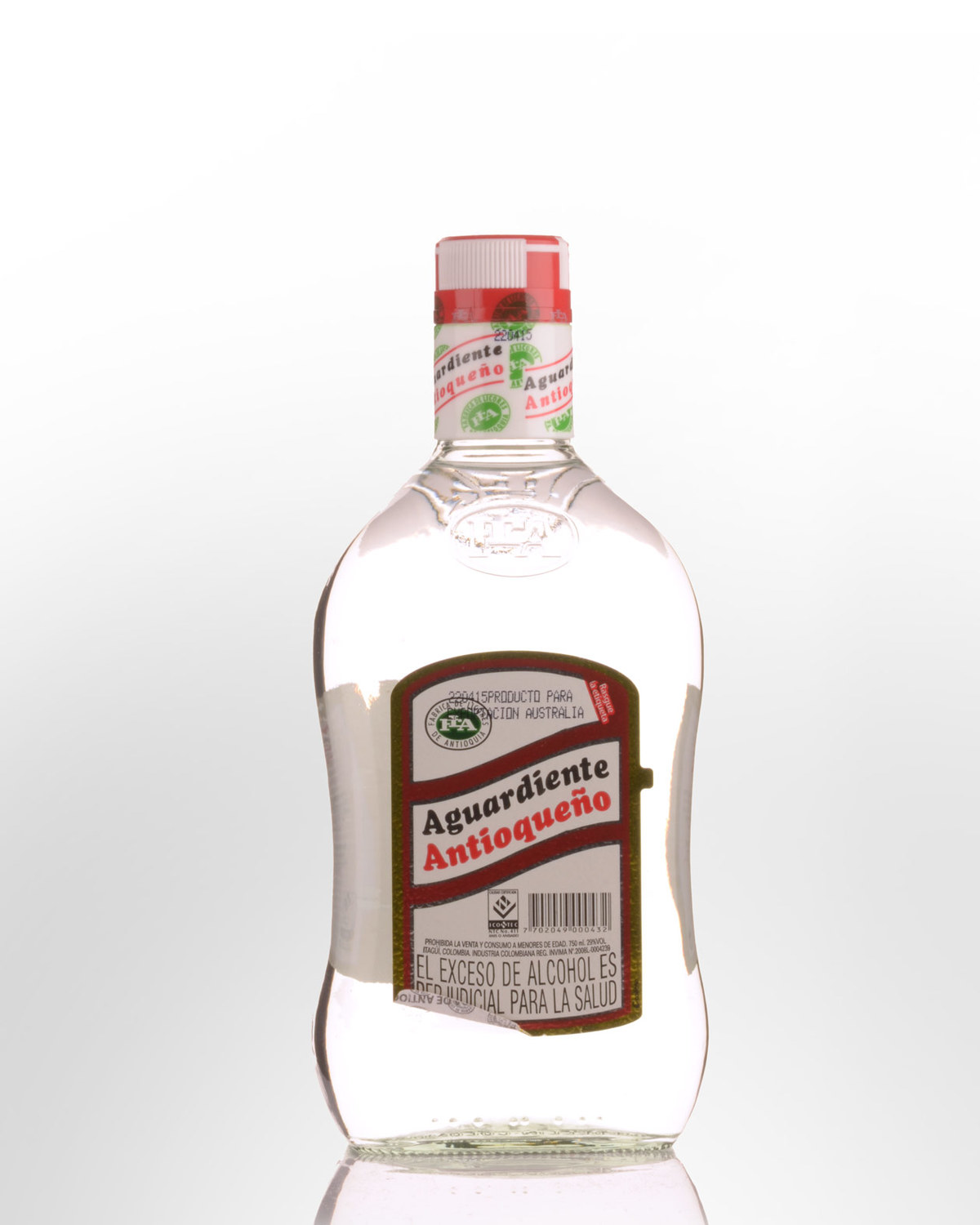
Antioqueno Aguardiente Traditional (750ml)COLOMBIA$54. 99Bottle$659.88 DozenABV: 29%Aguardiente Antioqueno is Colombia's and the world's largest selling Aguardiente. It is the nation's traditional drink, related closely to the regional celebrations and constumbres of the Colombian people, specially in Antioch where the farmers incorporate it to their own tastes. A natural anise-flavoured spirit derived from sugar cane distillate, the drink's popularity has been strong since the Spanish era, maintained in the Andean regions of Columbia, but not so often drunk in cocktails, rather usually enjoyed neat as a shot. Tasting note: Clear slightly viscous appearance. Moderately dry, light, pure aromas of anise lead into a relaxed, refreshingly dry anise driven delivery. Concludes clean and feather-light with an aftertaste that borders on neutral. A simple pleasure. 29% Alc./Vol.![1002022_1.jpg]()
- 89
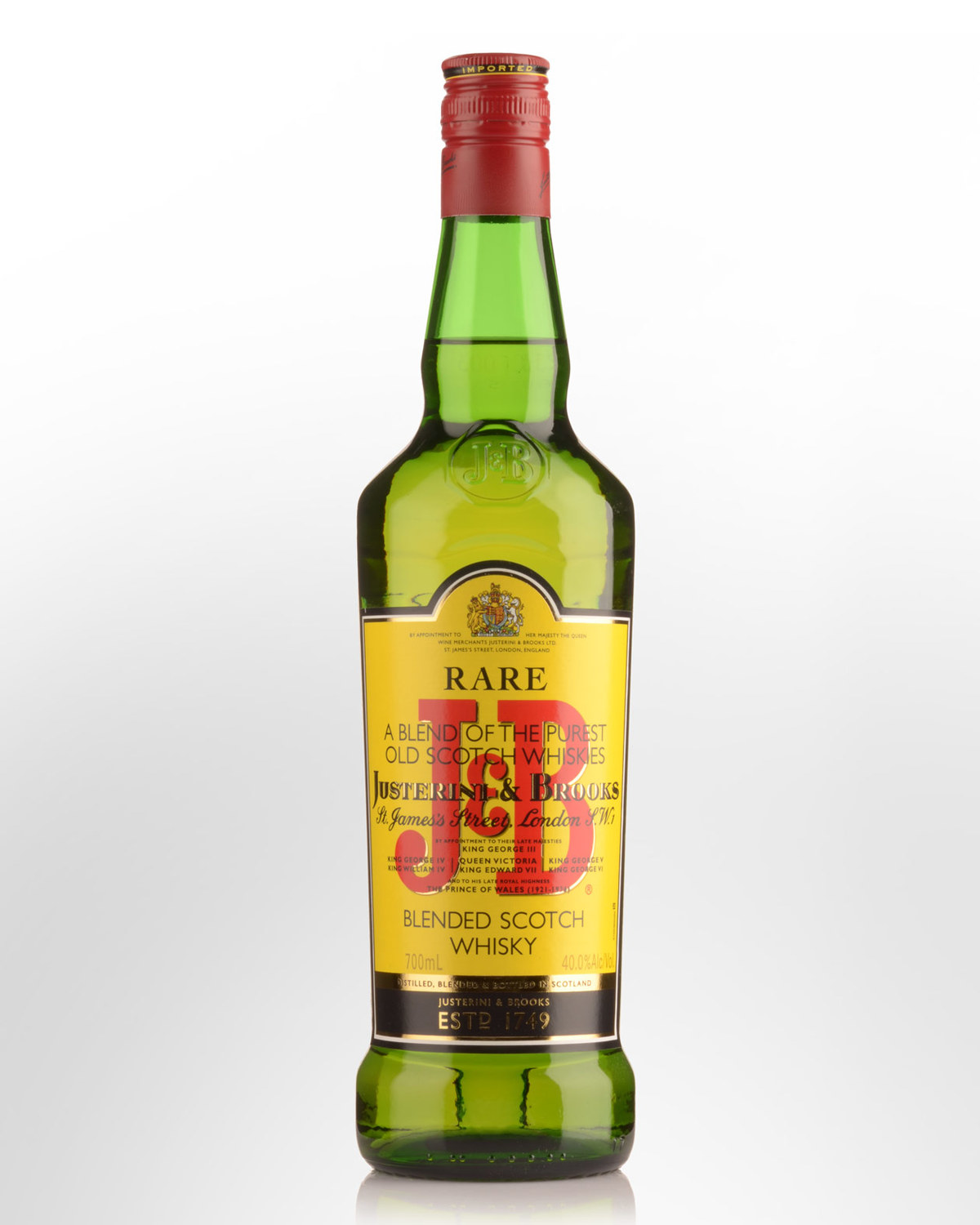
J&B Rare Blended Scotch Whisky (700ml)SCOTLAND$56. 99Bottle$683.88 DozenABV: 40%The blending of whiskies is a practise aimed at creating a product of broad appeal. It was for this purpose that Justerni & Brooks developed their now famous J&B Rare for the American market. By using a high proportion of the softer Lowland malts, J&B achieved a classic in its genre which remains one of the biggest selling whiskies on the American market.
Over 40 different malt and grain whiskies are matured and then married together for an unusually long time. Distilled, blended & bottled in Scotland.
Tasting note: [2012 bottling] Pale straw colour. Nosing reveals toasty cereals, vanilla wafer and a whisper of peat. Aeration releases more cocoa. Light to medium bodied. Exhibits a lovely malt/grain balance with gentle spices and a fluff of peat adding depth at mid palate. Finishes crisp, clean and beautifully dry with good persistence. In its latest incarnation, one of the best value blends on the market.
40% Alc./Vol.![501540222_1.jpg]()
- 91
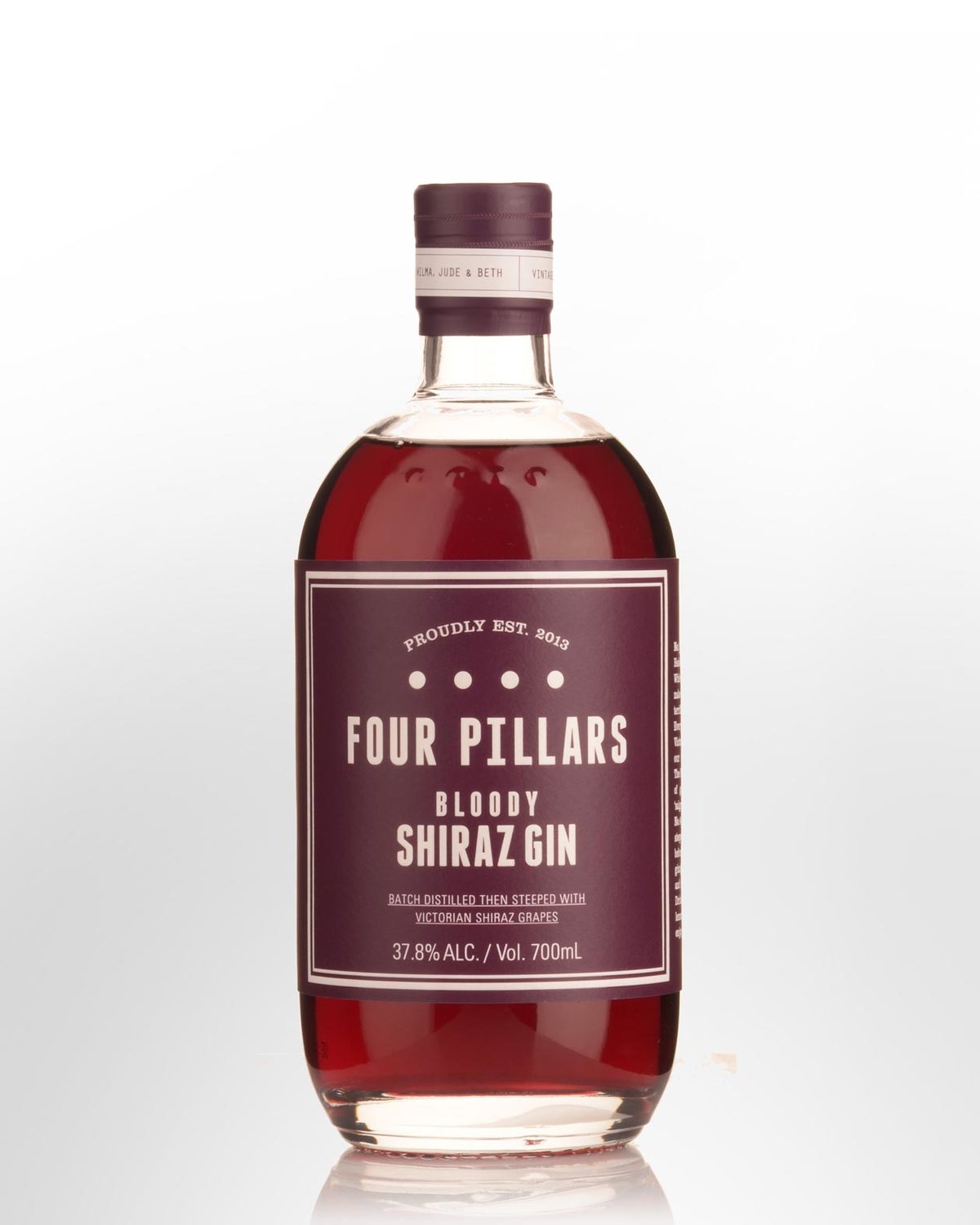
Four Pillars Bloody Shiraz Gin (700ml)Yarra Valley, Victoria, AUSTRALIA$85. 99Bottle$1031.88 DozenABV: 37.8%As close as a Gin comes to a cult following! Yet another 'vintage' of this novel Aussie release has been made by steeping Yarra Valley Shiraz grapes in gin for eight weeks. The fruit was de-stemmed but kept mainly as whole berries, and the tanks were kept cold and stirred daily. After eight weeks the fruit was pressed before blending with more Gin. The final product was bottled unfiltered and is expected to develop secondary fruit characters beyond two years, but should be best consumed within two years of vintage. Notes from Four Pillars... (2017 release) The beauty of Bloody Shiraz Gin being a product of vintage means that it will never be the same. Our 2017 release has an incredibly vibrant ruby colour, which turns iridescent pink when mixed with tonic or soda. Aromatically the gin has fresh pine needles and incredible spice, and a clear peppery, dense raspberry character. The palate is lovely and sweet, with long juniper and spice characters to finish. This release is slightly lighter in colour than last year's, due to a cool vintage in the Yarra Valley with a moderate ripening period. Unlike Sloe Gin, the alcohol is 37.8% (rather than <30%) so it packs a punch and is ideal in a range of cocktails. 2016 release tasted... Deep purple with mauve edges. Berry tart, stewed plum and light pepper/paprika aromas over background juniper and grapefruit. Medium bodied with soft, silky, off-dry, juicy plum and raspberry tart flavours and a delicate grapefruit, cinnamon, white pepper, piney-juniper finish. Ends medium long, slightly sweet, with subtle spicy red fruits in the aftertaste. A delicious, creative and cleverly balanced take on traditional sloe gin. 37.5% Alc./Vol. 91 points![1026955_1.jpg]()
- 90
- 92
Moet & Chandon Brut Imperial Rose ChampagneChampagne, FRANCE$120. 99Bottle$1451.88 DozenABV: 12%Closure: CorkOther Reviews....
Composed of 40-50% Pinot Noir (including 10% of red wine), 30-40% Pinot Meunier (of which 10% is red wine) and 10-20% of Chardonnay, including 30% of reserve wine. Rosé Impérial has a spontaneous bouquet of red berries, rose petal, white pepper, and touches of lemon. Fleshy and juicy, the texture is perfectly balanced, moderately weighted, and clear. Finishes long and minty. Dosage: 9g/L.
90 points
Decanter.com
Pouring an electric pink color, the NV Champagne Imperial Brut Rosé is initially a bit reserved aromatically and opens to juicy aromas of apricot, pressed flowers, and fresh berries. Fluffy and inviting, it’s primary with ripe red fruit through the palate and has a clean and supple finish. Easy-drinking and poppy with fruit, it’s marked by notes of late summer fruits without feeling cloying on the finish. Drink it now or over the next few years.
92 points
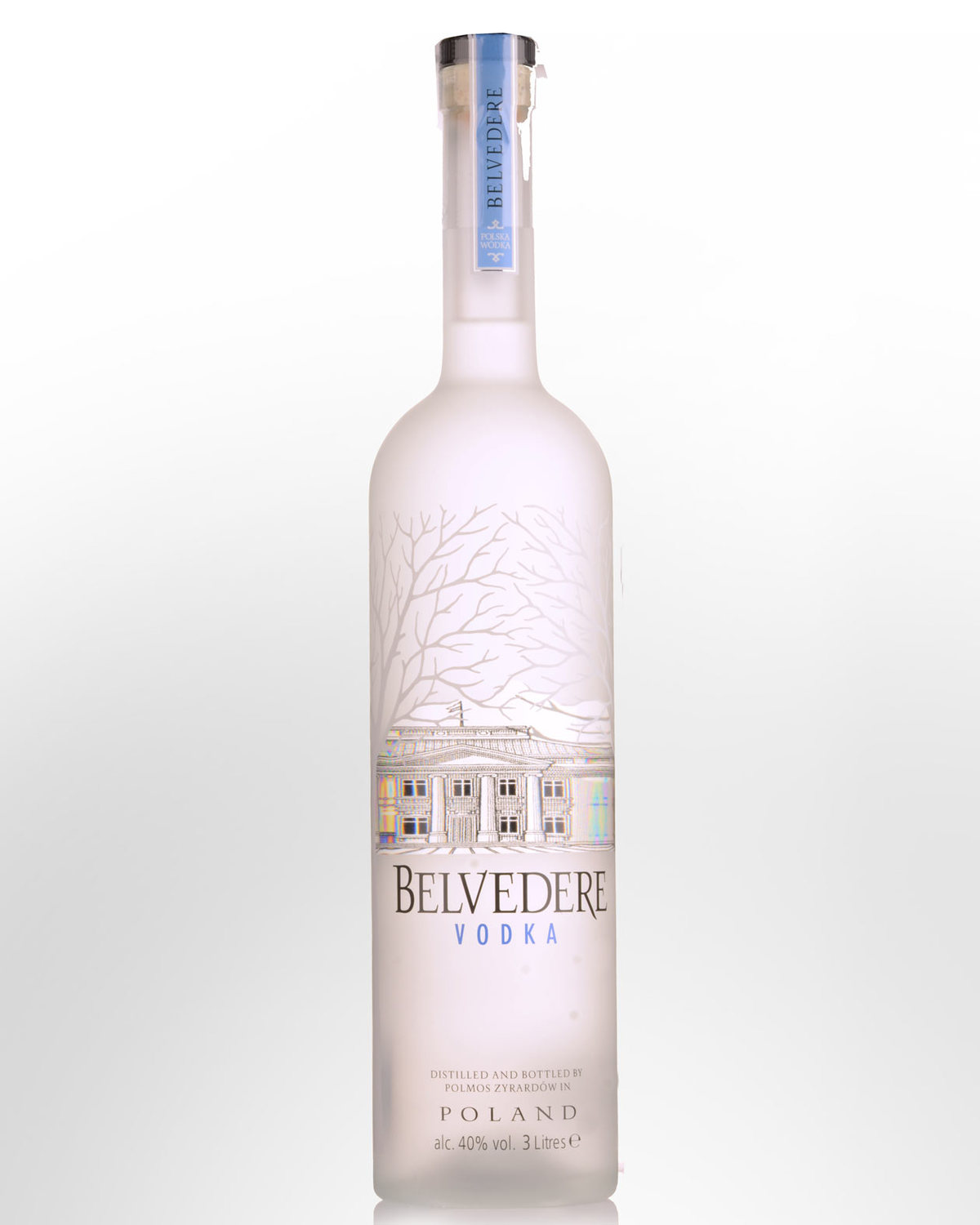
Audrey Frick - JebDunnuck.com![156045777_1.jpg]() Belvedere Vodka (3000ml)POLAND$385. 00Bottle$4620.00 DozenABV: 40%Belvedere, the luxury vodka brand, is now more impressive than ever in this super-sized 3 litre format! Belvedere Vodka from Polmos Zyrardow is crafted from 100% Polish rye, distilled four times and charcoal filtered. Easily recognised by its innovative packaging, the bottle depicts the Belvedere House, the Polish equivalent to the White House, the official residence of the Polish president in Warsaw. 40% Alc./Vol.
Belvedere Vodka (3000ml)POLAND$385. 00Bottle$4620.00 DozenABV: 40%Belvedere, the luxury vodka brand, is now more impressive than ever in this super-sized 3 litre format! Belvedere Vodka from Polmos Zyrardow is crafted from 100% Polish rye, distilled four times and charcoal filtered. Easily recognised by its innovative packaging, the bottle depicts the Belvedere House, the Polish equivalent to the White House, the official residence of the Polish president in Warsaw. 40% Alc./Vol.![8502621680_1.jpg]()
- Nicks Import
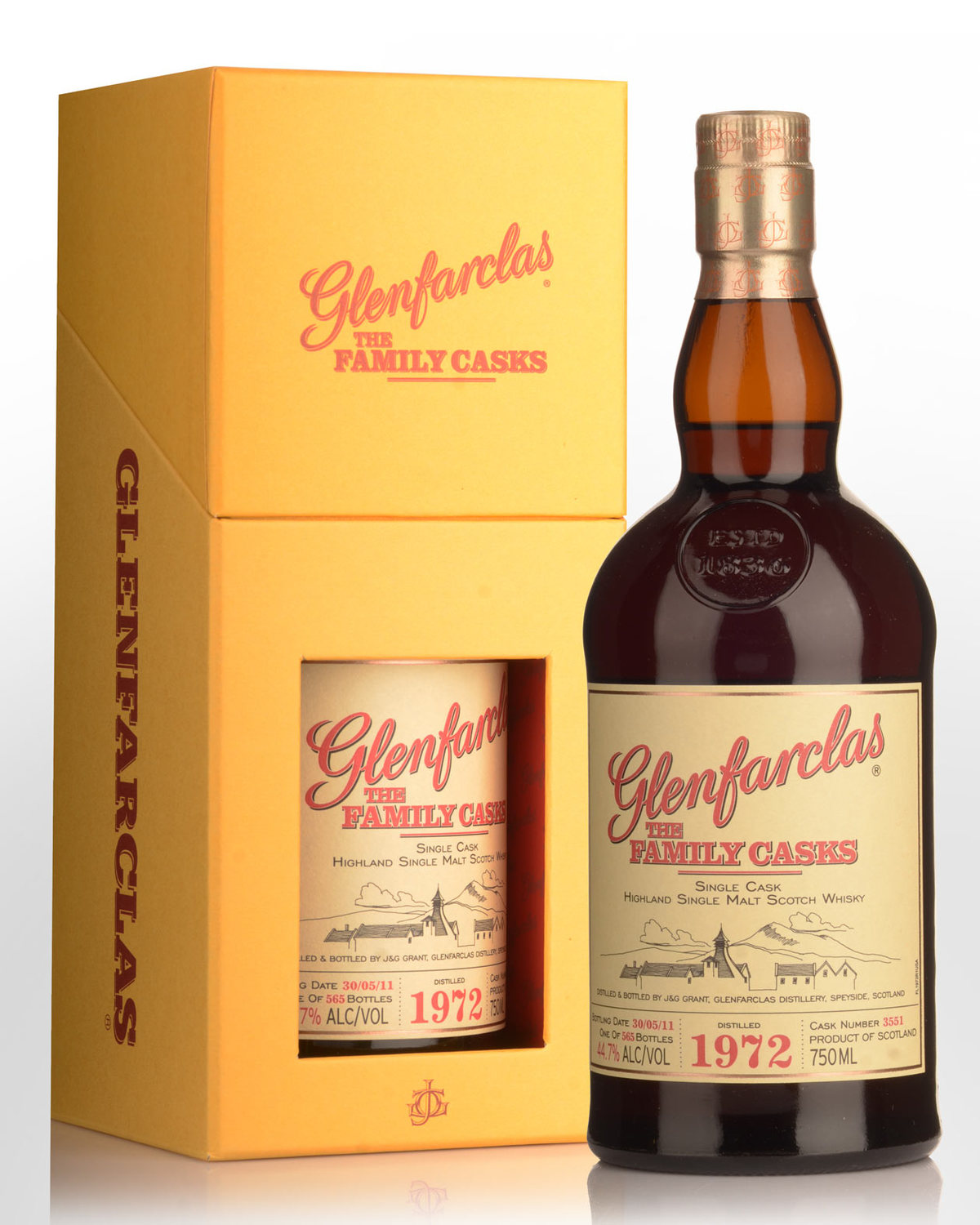
1972 Glenfarclas The Family Casks Cask Strength Single Malt Scotch Whisky (750ml)Speyside, Highlands, SCOTLAND$5999. 00Bottle$71988.00 DozenABV: 44.7%The Family Cask prices have been steadily increasing over the last few years, especially in emerging Asian markets. Word has it that demand has been so strong that Glenfarclas have even stopped issuing tasting notes for the various casks. Instead, they literally reserve every last drop for the whisky trade. Several vintages are increasingly rare even in the distillery’s warehouses and may represent their final stocks. Distilled in 1972 and drawn from a single cask #3551 before being bottled in 2011, this 39 year old edition had an outturn of 565 bottles. Note: 750ml bottle, so there's an added bonus! 44.7% Alc./Vol.![Cragganmore Distillers Edition Double Matured Single Malt Scotch Whisky (700ml)]()
- 90
- 89
- 85
- Distilled/bottled dates may vary
- Packaging may vary
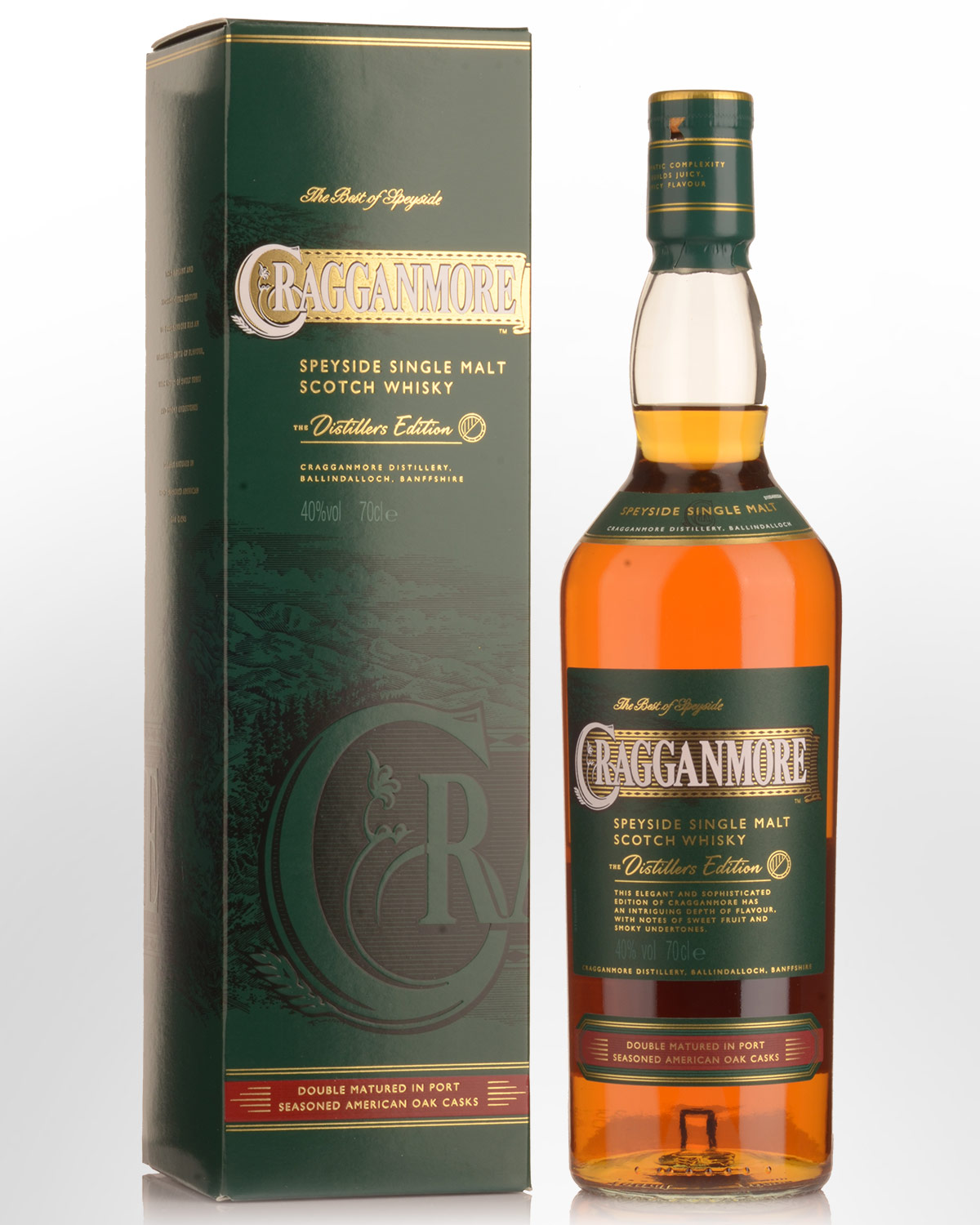
Cragganmore Distillers Edition Double Matured Single Malt Scotch Whisky (700ml)Speyside, Highlands, SCOTLAND$139. 99Bottle$1679.88 DozenABV: 40%All six of Diageo's 'Classic Malts' have released limited edition 'Distiller's editions', which are finished in special casks selected by the master distiller. The Distiller’s Edition Cragganmore returns to the past and brings a new dimension to this benchmark malt, via the finishing of the whisky in Port-wine cask wood. Doing so, Cragganmore’s Master Distiller has found a wonderful partner, adding succulent plummy fruit notes to the malt. Aromas of light caramel fudge, cinnamon and vanilla. Later passes reveal a fruity aspect as honey drizzled pear and light prune over toasted oatmeal. A relaxed, medium-bodied malt offering spiced plum, blueberry muffin (?) and vanilla flavours rounded off with a peppery flourish. More depth on the finish. The port adds a discreet enhancement and there's distant peat in the aftertaste. Eminently drinkable. 40% Alc./Vol.
Other reviews... The tightly closed fruit on the palate doesn't quite match the more complex and expansive nose. 85 points - Jim Murray's Whisky Bible 2017
...Cragganmore is a deep malt but its richness is often obscured by its fruity sweetness. A period in port pipes allows this element to be amplified. The black currant is now fully fruited and acts as a flavor bridge while the meatiness that sits underneath and often unseen is revealed. Think cherry pipe tobacco, clove, and dark fruits. Sweet, but not too sweet, and always identifiably Cragganmore. For me, the pick of the bunch. 89 points - whiskyadvocate.com
![1979 Comte de Lamaestre Vieil Armagnac (700ml)]()
- 93
1979 Comte de Lamaestre Vieil Armagnac (700ml)Armagnac, FRANCE$199. 99Bottle$2399.88 DozenABV: 40%Armagnac from the Bas region is considered to have the most finesse, also tending to yield spirits that are very supple in their youth. Plantings are mostly Bacco and Ugni Blanc. The Northwestern portion of the Bas-Armagnac (known casually as the Grand Bas Armagnac) has a concentration of quality producers, especially in the department of Les Landes.
Tasting note: Deep polished copper colour. Exudes sweet aromas of dates, toffee apple, vanilla, chocolate and nutmeg. The palate is full bodied, plush and round with medium dry flavours of dates, cocoa and soft spice perfectly counterpointed by drying and slightly grippy tannins. Dried apricot, nutmeg and clove aftertaste reverberates with surprising length, echoing back minutes after the final sip. Bottled 6th June 2008. 40% Alc./Vol.
Click here to learn more about Armagnac![456623434232_1.jpg]()
- 94
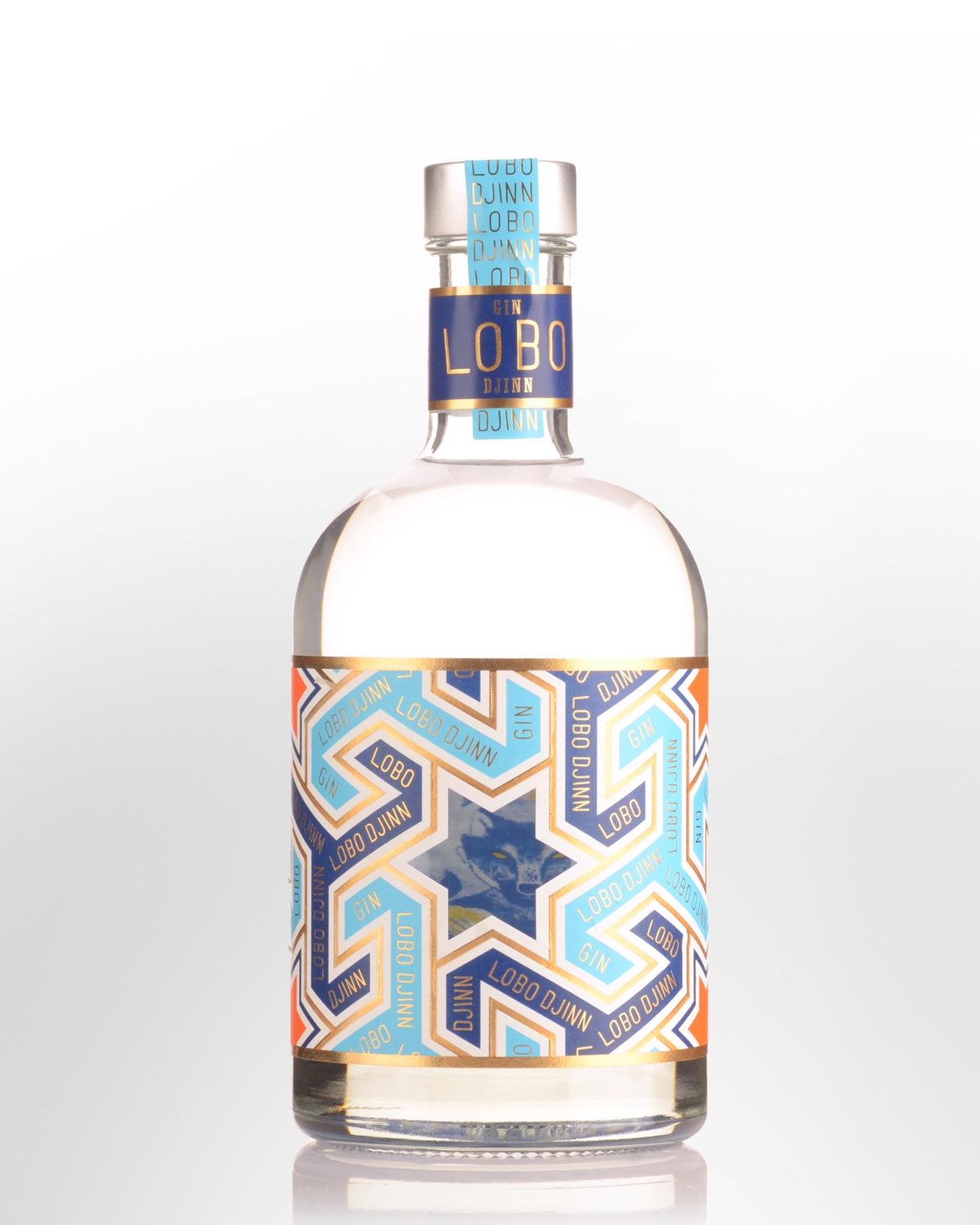
Lobo Djinn Gin (500ml)Adelaide Hills, South Australia, AUSTRALIA$72. 99Bottle$875.88 DozenABV: 41.6%A gin from the Adelaide Hills employing quince instead of the more typical citrus, backed up by a pure juniper note and supported by a blend of botanicals with spices and some other "ethereal notes". The juniper character stands up in classic cocktails, however the house cidermaker's favourite is a simple gimlett with straight lime juice. Tasting note: [20ml sample] Creamy yet fresh aromas of green pear, pine buds, earthy juniper, liquorice root and emerging anise. Great balance and length with a superb rush of anise(?)-laced juniper through the middle stages. Ends cool-mint fresh, delicately peppery with subtle pine, quince and aniseed lingering. Delicious. 41.6% Alc./Vol.![4077702_1.jpg]()
- 96
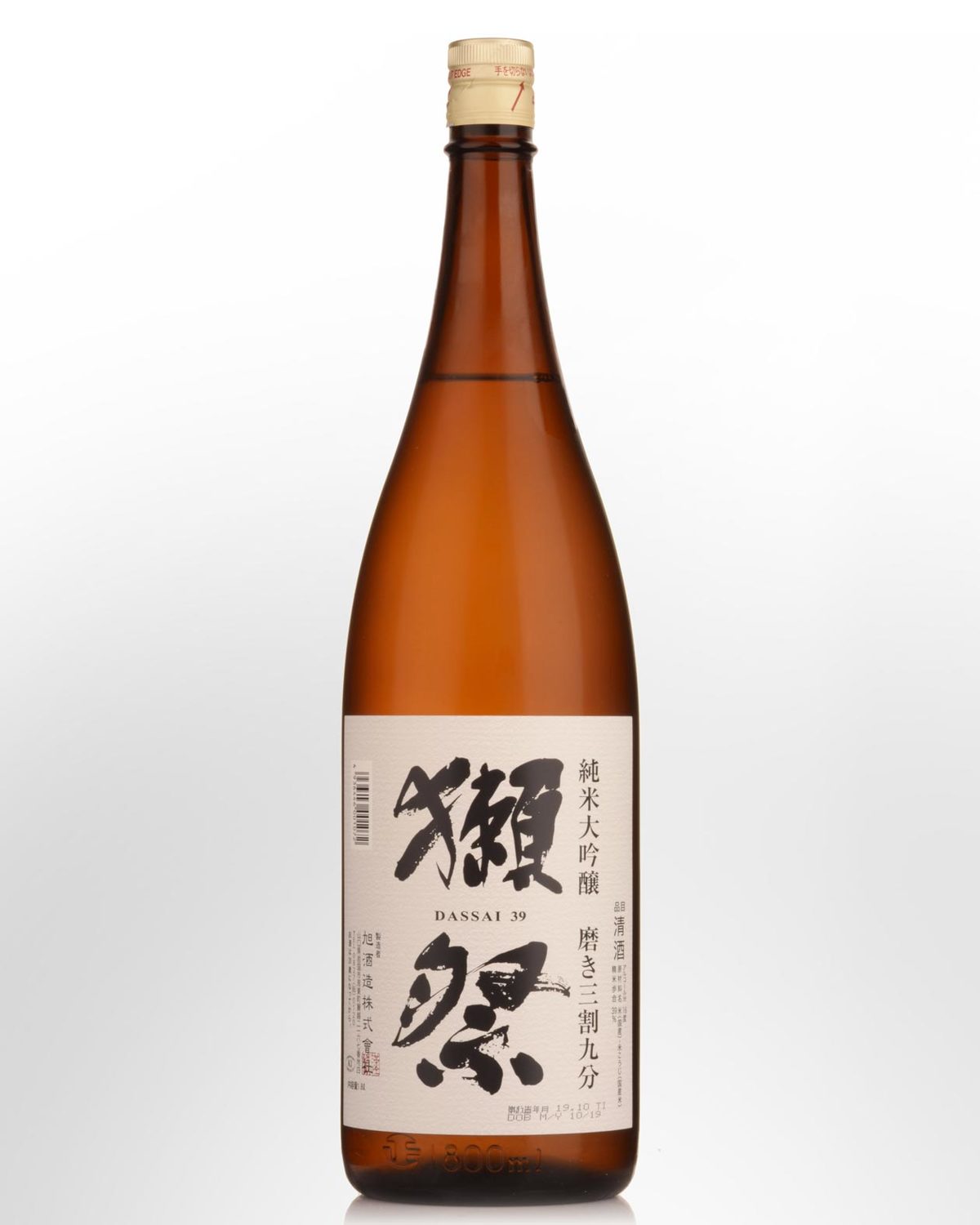
Dassai 39 Junmai Daiginjo Sake (1800ml)Yamaguchi, JAPAN$160. 00Bottle$1920.00 DozenABV: 16%Closure: Plastic StopperDassai, brewed by Asahi Shuzo in Yamaguchi Prefecture, is dedicated exclusively to Junmai Daiginjo sake made with the highest level of rice polishing for purity and elegance. Using only Yamada Nishiki, the most prized sake rice, Dassai embraces a supremely modern approach, blending tradition with innovation. Unlike most breweries that follow a seasonal brewing cycle, Dassai operates year-round, refining their techniques to achieve precision and consistency. The result is a range of exceptionally smooth, fragrant, and expressive sake that has gained a global following.
Striking a balance between elegance and depth, Dassai 39 embodies the harmony of meticulous craftsmanship and expressive character. It offers a polished yet approachable take on the Dassai style.
Tasting Note: Pours a pale, water white colour in the glass. Displays a highly engaging nose of white florals, strawberry and cream, along with green melon, honeydew, and a hint of spearmint lift. The palate is equally as pretty with flavours very much fruit driven rather than the more common rice and yeast notes. Green melon, white peach, and pear lead out, supported by nougat, cream, with a touch of jasmine rice and subtle sweetness on the finish the only clue to its origin. What stands out is how elegant and pure this sake is, showing more in common with an aromatic white wine than is the norm. A very modern take, and one well suited to clean and fresh food matches such as kingfish sashimi or shellfish dishes. Highly recommended. Serve chilled.
Alc 16%
Rice Polishing: 39%![1026262_1.jpg]()
- 90
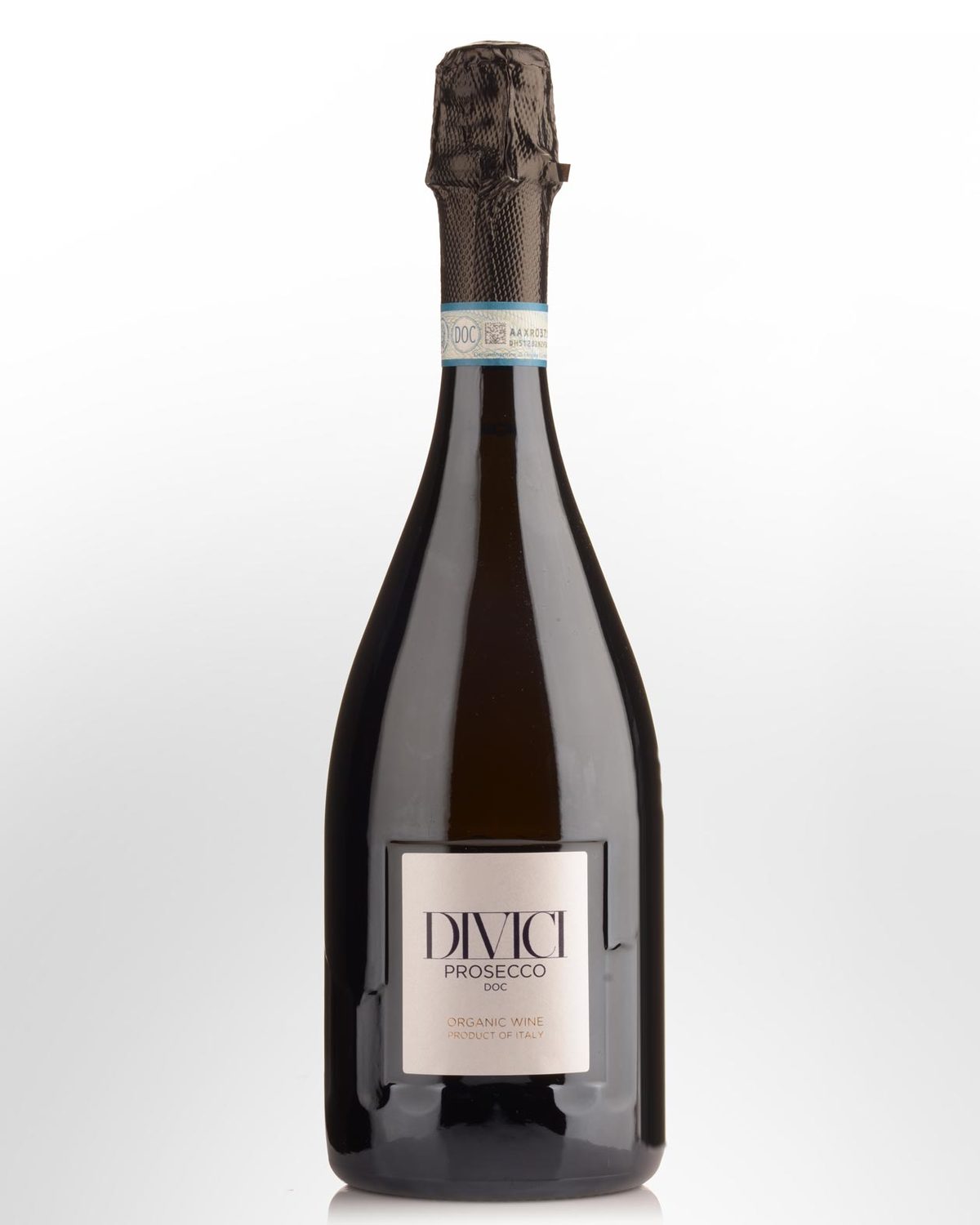
Divici Prosecco DOC Extra DryITALY$22. 99Bottle$275.88 DozenABV: 11%Closure: CorkPours with a moderate mousse that dissipates relatively quickly to reveal a very pale straw base wine colour. Very fine bead showing good persistence. The nose exhibits top notes of citrus and fresh apple followed by some toasty characters. Light and crisp the palate delivers delicate flavours of pear and apple followed by some subtle yeasty characters on the back palate. Clean dry finish with aftertaste of pear, citrus and yeast lees.
Drink now.
Alc 11%![Zubrowka Bison Grass Flavoured Vodka (700ml)]() Zubrowka Bison Grass Flavoured Vodka (700ml)POLAND$59. 99Bottle$719.88 DozenABV: 37.5%
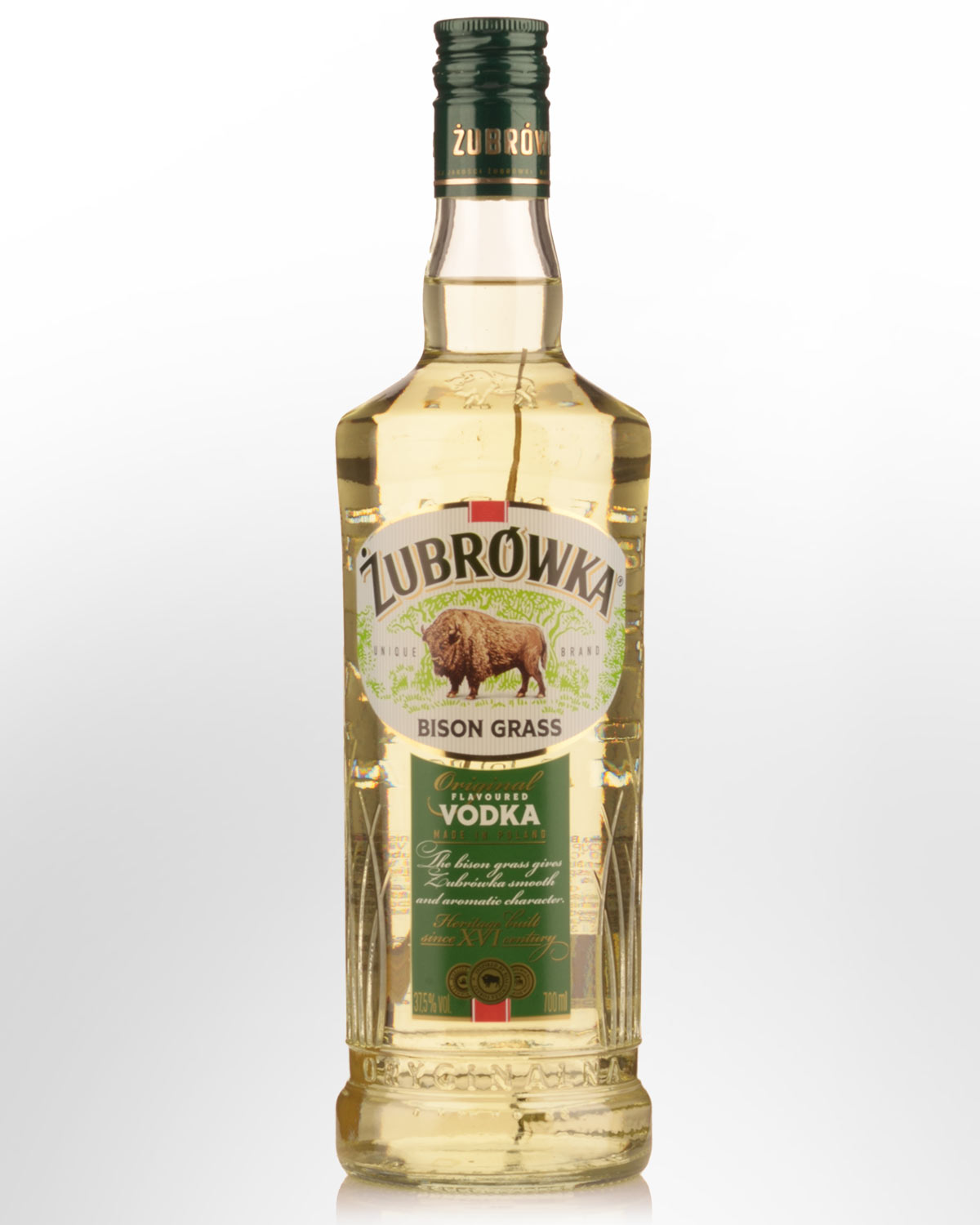
Zubrowka Bison Grass Flavoured Vodka (700ml)POLAND$59. 99Bottle$719.88 DozenABV: 37.5%Premium, specialty flavoured vodkas have become increasingly fashionable over the last decade. Long before the marketing gurus capitalised on this trend, however, there existed 'Bison Grass Vodka.'
"…it smells of freshly mown hay and spring flowers, of thyme and lavender, and it's soft on the palate and so comfortable, it's like listening to music by moonlight." At least Isabel thought so in Somerset Maugham's novel The Razor's Edge. Perhaps the author felt the same way. "It's funny, its colour is just like its smell. It's like that green you sometimes see in the heart of a white rose…"
The source of Zubrowka's wealth of qualities is a plant of unassuming appearance called sweet grass, holy grass, Seneca grass or vanilla grass, or in Latin Hierochloe odorata. In Poland it is referred to as bison grass (bison in Polish is zubr). Bison grass contains coumarin, a glycoside with a distinctive fragrance, once generally used to flavour tobacco, cakes and beverages. Today, because coumarin has been found to have anticoagulant properties, it is allowed only in tiny amounts which the Polish health authorities deem harmless. Zubrowka contains only about a dozen milligrams of coumarin per liter, derived from an infusion of one or two kilos of bison grass per thousand liters of vodka.
The wild-growing grass must be harvested in good weather and at the proper time - early in the summer, when the grass has reached the proper height and colour, but is still young and not yellowed. At that moment it is most aromatic. The grass is harvested by hand. Then it is allowed to dry naturally in the breeze and sunshine and is bound in bunches, cut to the required length and delivered to the distilleries. In the distillery the grass is spread on screens and vodka is made to flow through the grass several times to make an aromatic essence. During the next stage this bison grass extract is mixed with pure vodka until the right colour, aroma and taste are obtained, following the traditional recipe. The ready vodka is left for several days to stabilise and harmonise. Experienced technicians and tasters monitor every step of the process.Finally the vodka is filtered and the final product is bottled, with a blade of bison grass in every bottle for decoration.
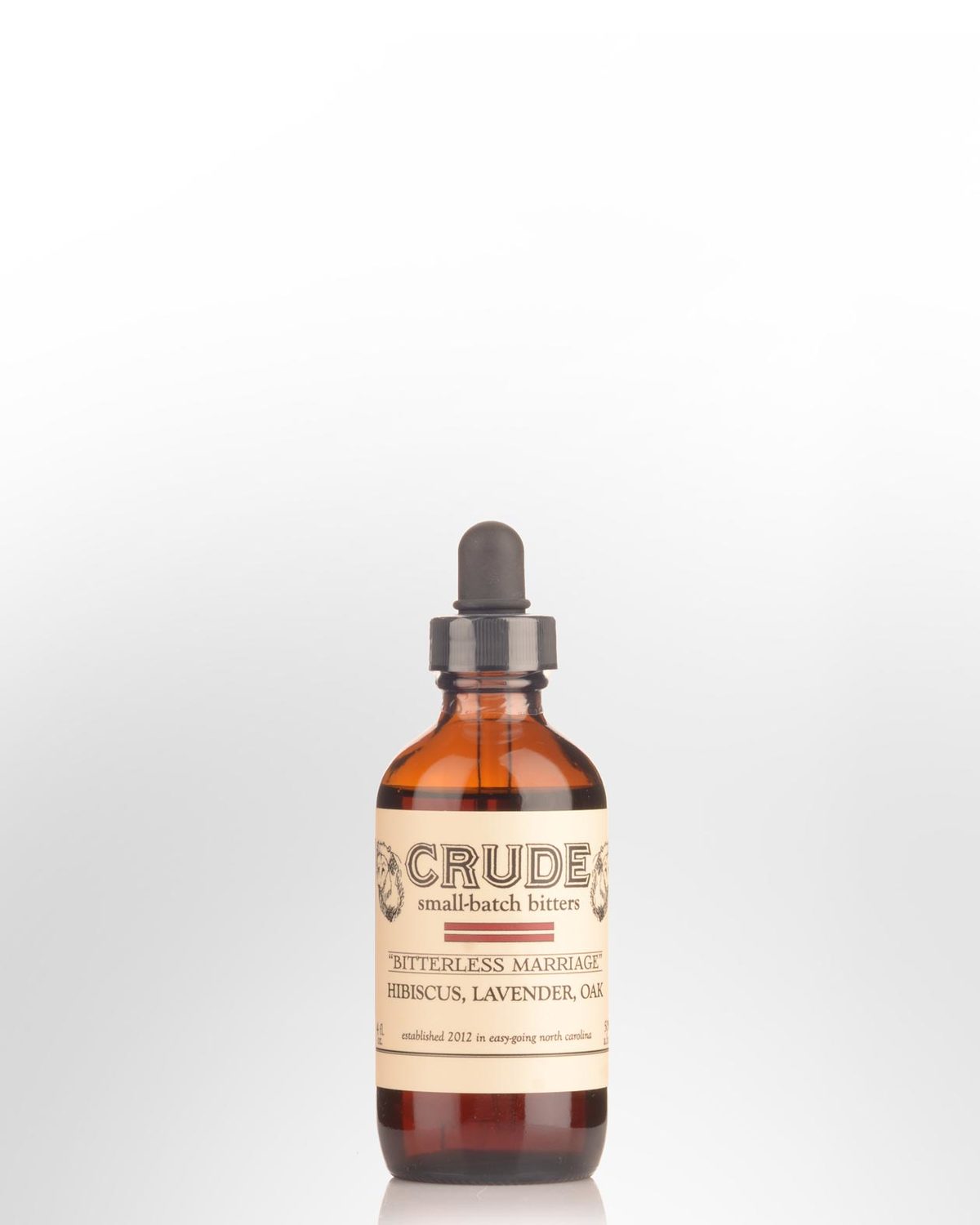
![9871230_1.jpg]() Crude Bitterless Marriage Hibiscus Lavender & Oak Bitters (120ml)UNITED STATES$34. 99Bottle$419.88 DozenABV: 50%This is Crude's take on a traditional aromatic bitters. Hibiscus provides a tart and fruitful base, lavender infuses a floral aroma to represent a bond, while the oak provides the depth and strength. Add a few drops to most light and dark spirits. 50% Alc.Vol.
Crude Bitterless Marriage Hibiscus Lavender & Oak Bitters (120ml)UNITED STATES$34. 99Bottle$419.88 DozenABV: 50%This is Crude's take on a traditional aromatic bitters. Hibiscus provides a tart and fruitful base, lavender infuses a floral aroma to represent a bond, while the oak provides the depth and strength. Add a few drops to most light and dark spirits. 50% Alc.Vol.![9342557000050_1.jpg]() Del Maguey Chichicapa Single Village Mezcal (750ml)Oaxaca, MEXICO$174. 99Bottle$2099.88 DozenABV: 46%Closure: Cork
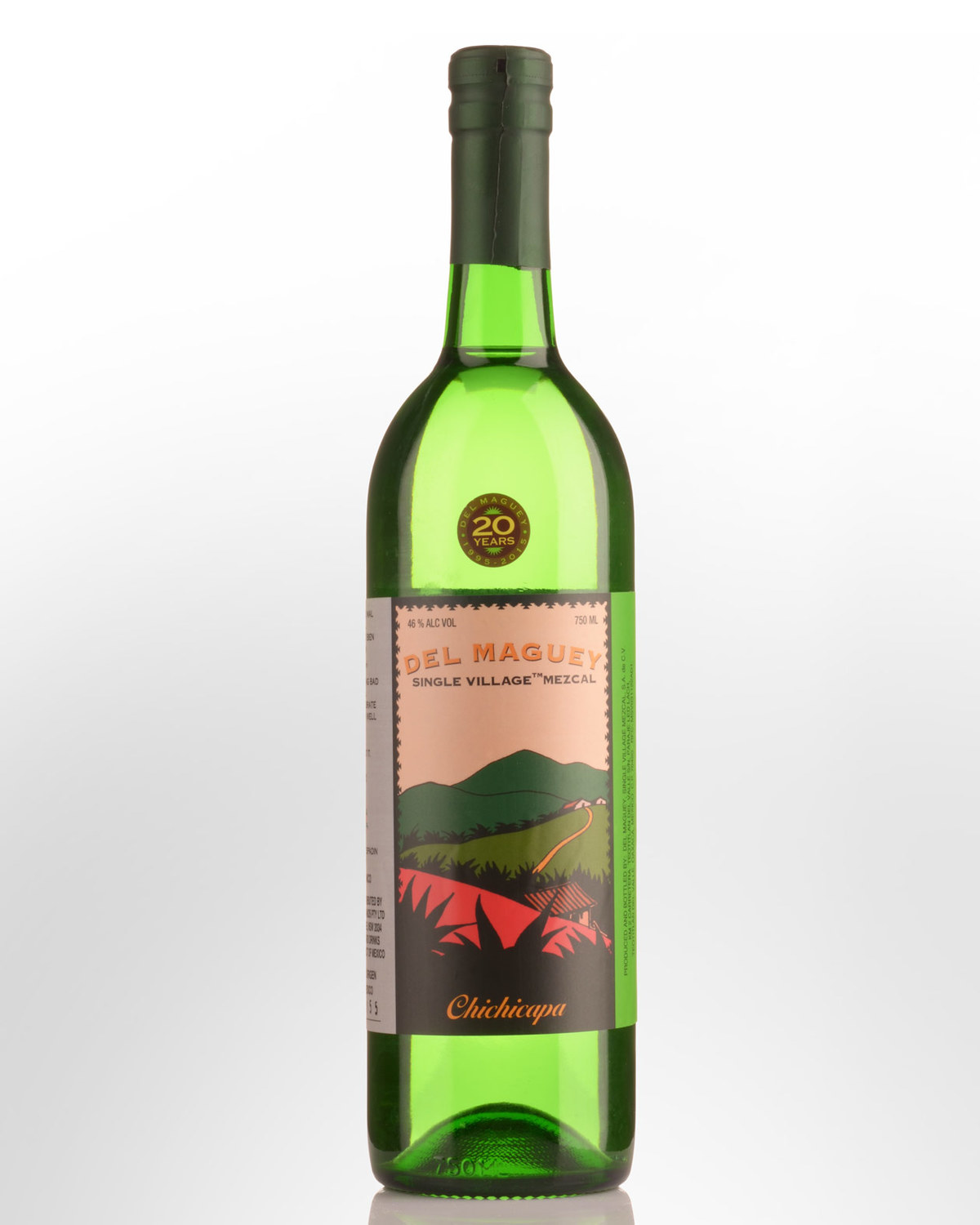
Del Maguey Chichicapa Single Village Mezcal (750ml)Oaxaca, MEXICO$174. 99Bottle$2099.88 DozenABV: 46%Closure: CorkHeirloom Spirits of the Zapotecs. Unlike tequila, mezcal has remained closer to its origins as a drink of villagers and artisan producers, persisting with tradition, as only mezcal can be made. It differentiates itself from tequila by a countrified approach taken by the distillers in the Oaxaca region (pronounced 'wa-ha-ka') who today produce around 60% of the total Mezcal output. It achieved Denominacion de Origen status in 2005. Unlike tequila, which employs only the Weber variety from fields around Jalisco, there are eleven types of agave, collectively known as ‘Maguey’ which are permitted in mezcal, such as the widely cultivated ‘Espadin’ or ‘Manso’ varieties and the more sought after wild ‘Tobala’ - the trophy of the mezcal world. Unlike tequila, mezcal is required to be at least 80% pure blue agave (tequila only 51%).
As awareness for mezcal has slowly grown, commercial opportunities have been harnessed. Keeping pace with demand (which remains insignificant in comparison to tequila), it’s now been made on a more industrial scale too. This has led to some bottlers adding cane alcohol, caramel, colour, sulphates, sweetener and even fertiliser, usually in order to speed up output. Drinking this stuff is like following cheap tequila down a dirty track towards an unforgettably brutal hangover. Don’t consider a worm in the bottle a sign of authenticity or quality either. Real mezcal is of another dimension, and it’s not easy to come by.
Even now, the only place to sample real Mezcal generally involves a trip to Oaxaca, and then out of town. Away from the big city is where its production remains rustic and unhurried. Initially the process resembles the manner in which primitive tribes cooked food in holes: Agave hearts are cooked in a conical pit in the ground. Stone and charcoal are heated in it and the agaves laid on top, covered with palm leaves, matting and soil, cooked for three to five days, taking on the aromas of smoke and earth. Left to cool for a week, wild fermentation begins following which the baked agaves are crushed. This often happens using horse driven millstones. The pulp is mixed with water and fermentation is completed in large vats. Rather humble copper or clay kettle stills are employed, wood-fired, and rarely more than 100 litres in capacity. Double distillation is the norm. Maturation may range anywhere between one month to over a decade.
One has to search for artisanal examples of this exotic spirit. That’s what modern day mezcal pioneer, Ron Cooper did. His conversion came about while looking for the best tasting mezcal to Christen a new sculpture with (Cooper is an established American artist). The Oaxaca locals pointed him towards the mountains. In the remote villages and foothills he discovered mezcals that tasted nothing like the ‘rot-gut’ so infamous in the Mexican cities. Yet, as Cooper realised, most people have no idea that these sorts of mezcals exist.
It was a revelation. He set about bringing the world’s attention to previously unavailable, 100% certified organic, artisanal mezcal produced the original handcrafted way. These mezcals can vary in taste as much as wines, and flavour wise, there’s virtually nothing like them in the world. Perhaps their only natural counterpart is smoky Islay Scotch (interestingly, Japan is one of mezcal's biggest export markets). Indeed, the relationship between mezcal and tequila has been equated to that of Islay malts vs the rest of the whisky world – exotic, assertive, smoky, briny even ‘industrial’ at times – that’s real mezcal.
In 1995 Cooper acquired a liquor license and established his own label, ‘Del Maguey’ (pronounced 'ma-gay'). His intention is to harness and showcase the varying micro-climates and regional differences that give his mezcals a unique character. No colourings or additives are used. Every product is made by individual family palenqueros (producers) in old-style villages. The villages are between two and eight hours from town. “One bus in and out every Sunday” kind of places, as Cooper says. It’s an approach that’s clearly inspired by European terroir. His is reputedly the first Bodega in more than 400 hundred years of mezcal production that has credited the name of each village where the liquid is made on its labels.
True to the nature of the spirit itself, Cooper’s venture has remained in keeping with its origins. One of his bigger years yielded all of 12,800 bottles - a miniscule output by world standards. With a dearth of anything but mass produced ‘commercial’ mezcals arriving on our shores, some of which have undoubtedly done the genre a disservice, we can consider ourselves fortunate that a small quantity of these rare heirloom spirits have now made their way into Australia. Very Limited Stocks.
Chichicapa is 2 hours south of Oaxaca, and 2 hours to the west on a dirt road. The elevation is about 7,000 feet. Chichicapa is separated from the valley of Oaxaca by a mountain range. The climate is desert and tropical, with banana trees, guava, mangoes and other exotic fruits. Faustino Garcia Vasquez is the maker of Chichicapa, a craftsmen with great respect for the ancient processes. His mezcal typically offers a relatively light nose, is deep and sweet with a distinct smokiness and hint of mint.
No tasting notes available.
Click here to learn more about Tequila & Mezcal
![Tullamore Dew Irish Whiskey (700ml)]()
- Packaging may vary
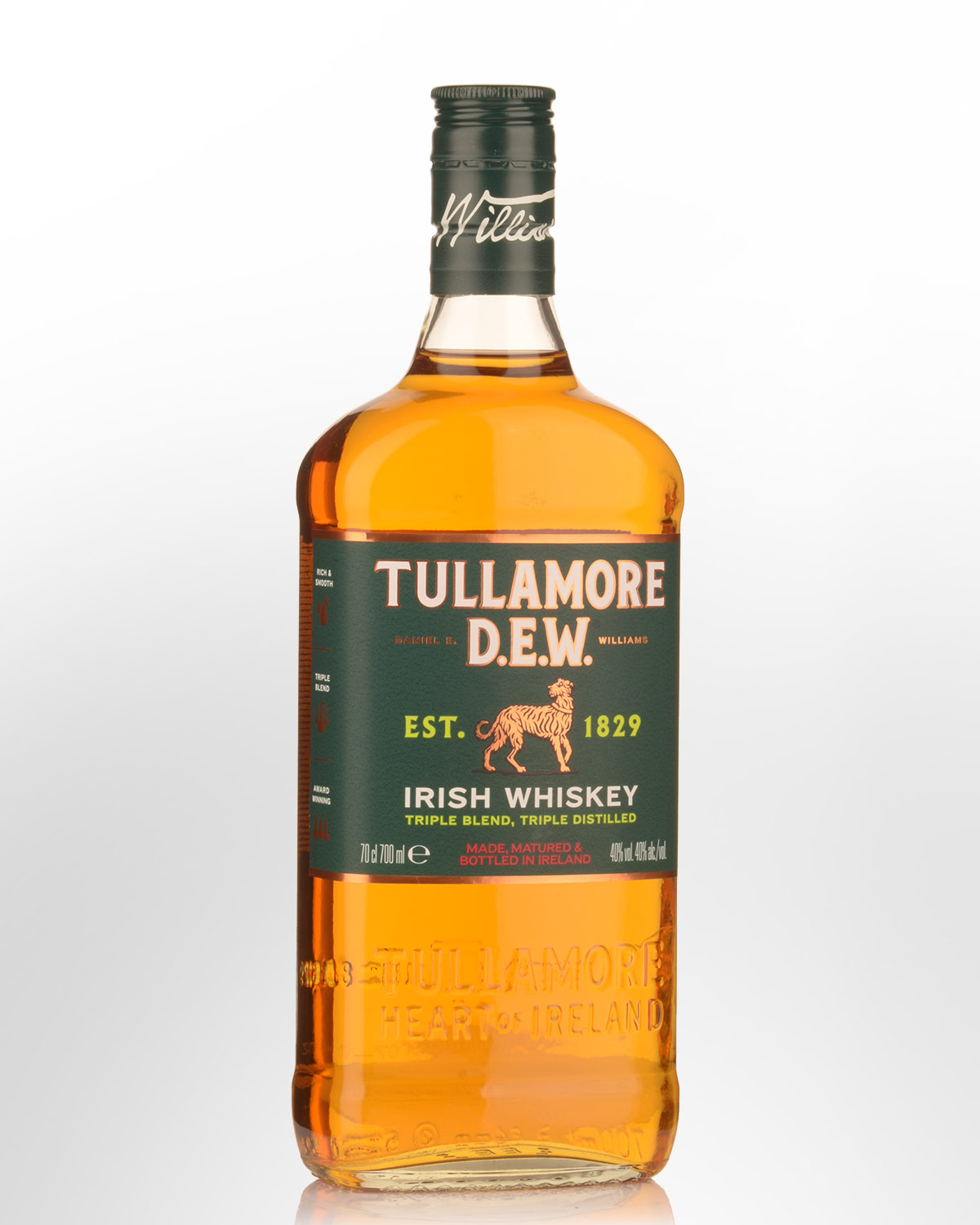
Tullamore Dew Irish Whiskey (700ml)Tullamore County, Offaly, IRELAND$58. 99Bottle$707.88 DozenABV: 40%One of Ireland's most widely distributed whiskeys, Tullamore Dew was first distilled in 1829 in the small town of Tullamore in County Offaly in the heart of Ireland. Today, more than 2,500,000 bottles are bought each year in over 80 countries. Perhaps the lightest of all the Irish Whiskeys, Tullamore Dew is very popular in France where it is pronounced 'tous l'amour' although the origin of the name is far less romantic. One of the distilleries most successful directors, Daniel E. Williams one day decided to add his initials to the product and Tullamore 'Dew' was born. Williams even coined the advertising slogan 'Give every man his dew.'Triple distilled, Tullamore Dew is about as mellow a drink as one can attain to without venturing into the world of liqueurs. Indeed, Irish whiskies are noted for their silkiness, which sometimes borders on being liqueur like. The problem with Irish whisky is taking it sanely and in moderation. Used improperly the effect is just as bad as stuffing on too many starchy foods, taking no exercise or disliking our neighbour. Used properly, one divines the full sense of the old saying 'Irish eyes are smiling.'
Other reviews... Pale golden amber color. Caramel, dried reed, and golden raisin aromas. A round entry leads to dryish medium-bodied palate with warm buttered caramel, toasted nuts, and delicate spice. Finishes with a nice, even caramel and spice fade. 40% Alc./Vol.
International Review of Spirits Award: Silver Medal
88 points (Highly Recommended).- www.tastings.com
![10223249_1.jpg]()
- 96
- 94
- Nicks Import
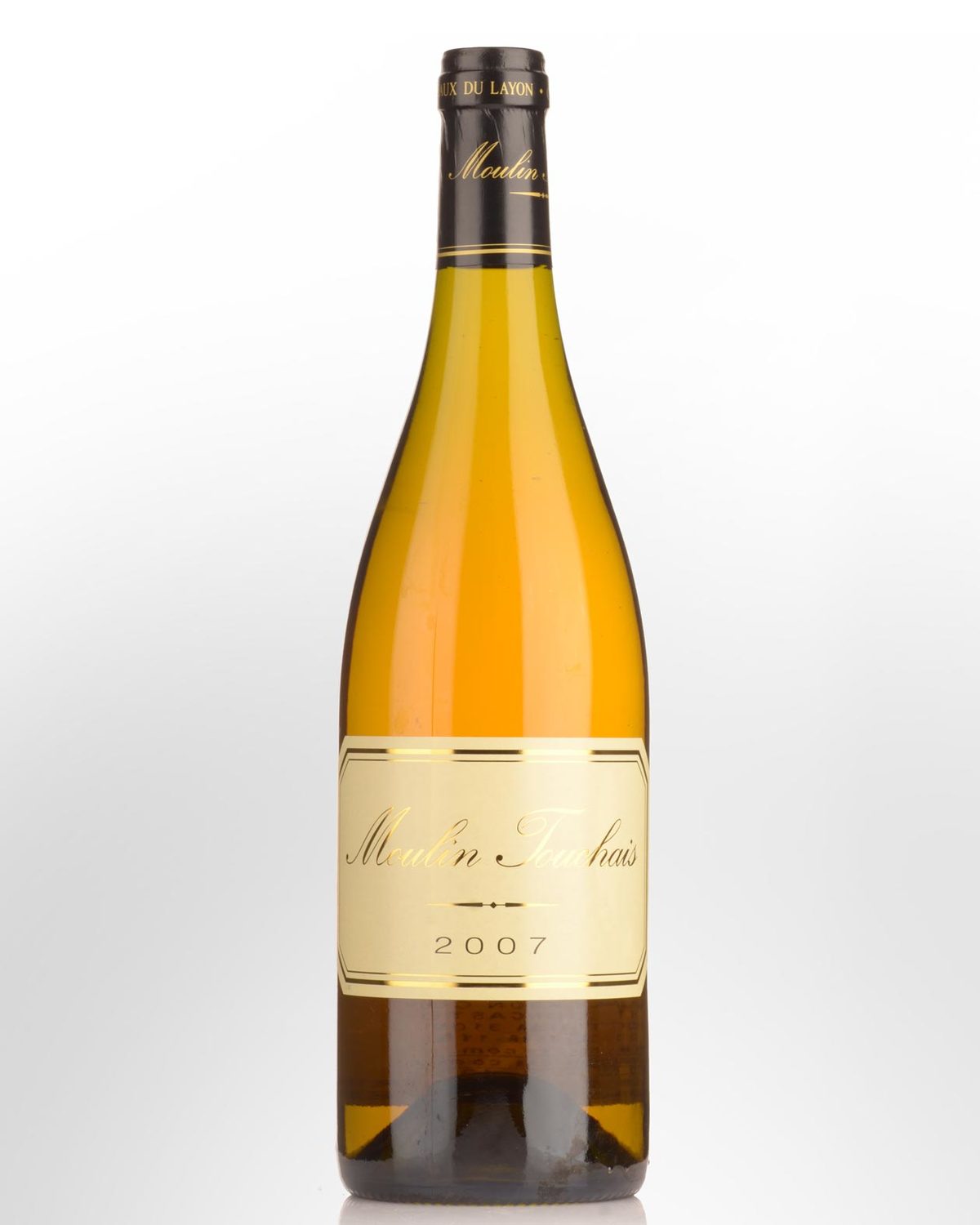
2007 Moulin TouchaisCoteaux du Layon, Loire Valley, FRANCE$84. 99Bottle$1019.88 DozenCellar: Drink now - 15 Years (2019-2034)ABV: 13%Closure: CorkThe wines of Moulin Touchais begin reaching their peak after twenty years, and many of the great vintages will take much longer. Vintages such as the 1953, 1959, 1964, 1969 are still maturing. The 1945, 1947 and 1949 have become classics. Moulin Touchais are the only winemakers in the world who give a century long guarantee on the longevity of their wines (subject to being kept under optimal cellar conditions). Bottles may show some sediment or deposit. One should understand this is due to the traditional filtration process, the main aim being to protect the colour, the bouquet and the depth of flavour of the wine.
Bright golden colour with brassy gold edges and a very pale gold hue. Pronounced brown pear, honeyed quince and toffee apple scents mix with hints of butterscotch, cinnamon and raisins. Broader and showing more viscosity the 2005 vintage, the palate is fat in juicy in texture but not cloying, delivering an intense flavour profile of ripe pears, honeyed characters and baked apple that sit over a back drop of quince, subtle notions of marmalade and spice. Round, luscious finish with a long honeyed drenched aftertaste of pear, baked apple and quince.
Drink over the next 10-15 years.
Alc. 13%Other Reviews....
Unctuous, with sweet corn, saffron and raisin notes, while a second layer offers more exotic guava and mango fruit. This opens up with some air and delivers even more complexity. Pretty vibrant and graceful, showing good definition, range and balance. Drink now through 2037
94 Points
winespectator.com![5252965495_1.jpg]()
- 89
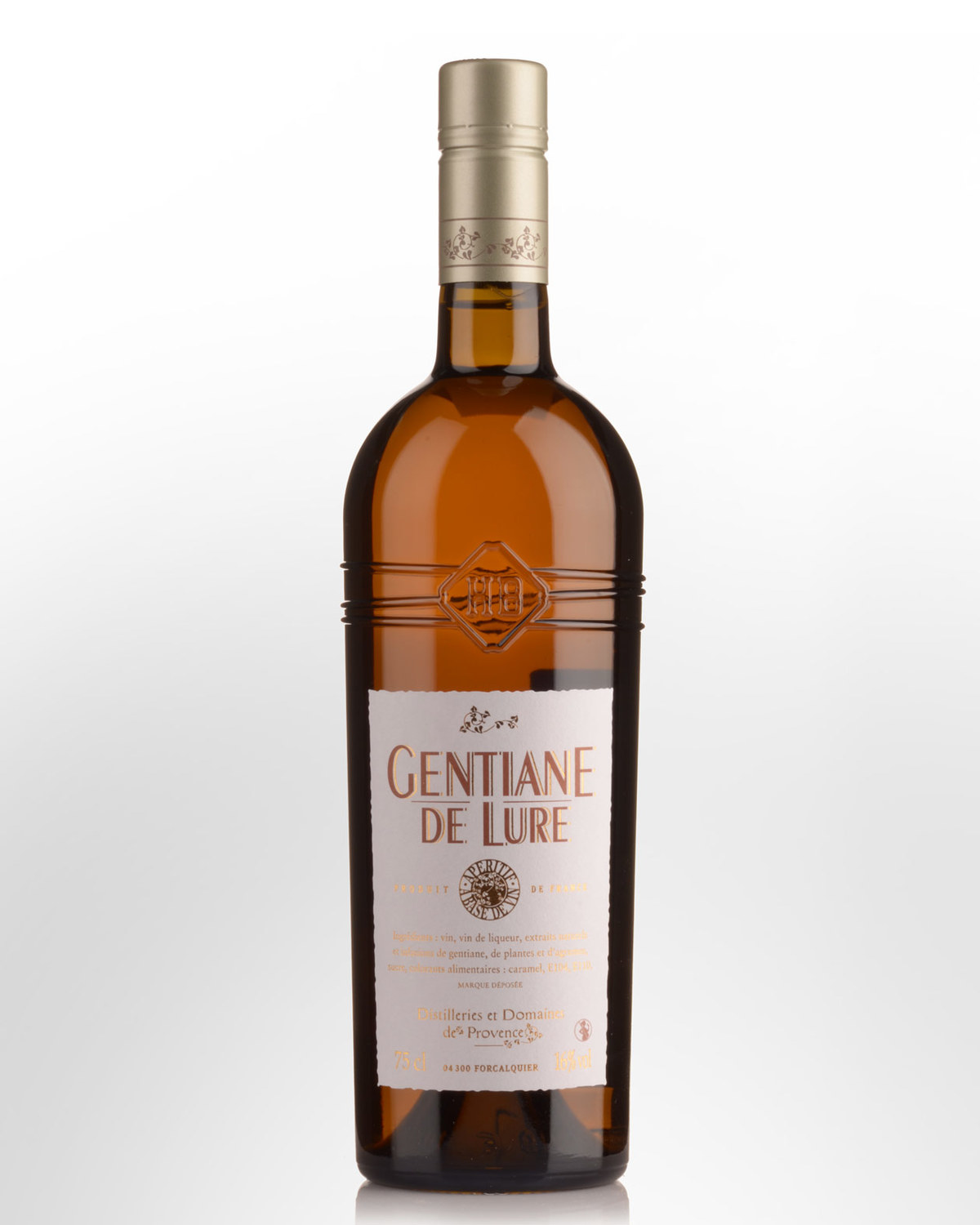
Distilleries de Provence Gentiane de Lure Aperitif Liqueur (700ml)Provence, FRANCE$47. 99Bottle$575.88 DozenABV: 16%An infusion of gentian roots and wine. Tasting note: Saturated gold / pure amber colour. Almost bitter-sweet as gentian underscores the candied orange peel note. Second pass finds candied blood orange dominating. The light to medium bodied profile features fresh, juicy orange peel / pulp, becoming delicately bitter at the finish as citrus peel and gentian follow through to the fade. Simple yet so refreshing! 16% Alc./Vol.![3789279878279_1.jpg]()
- 87
- 84
- Nicks Import
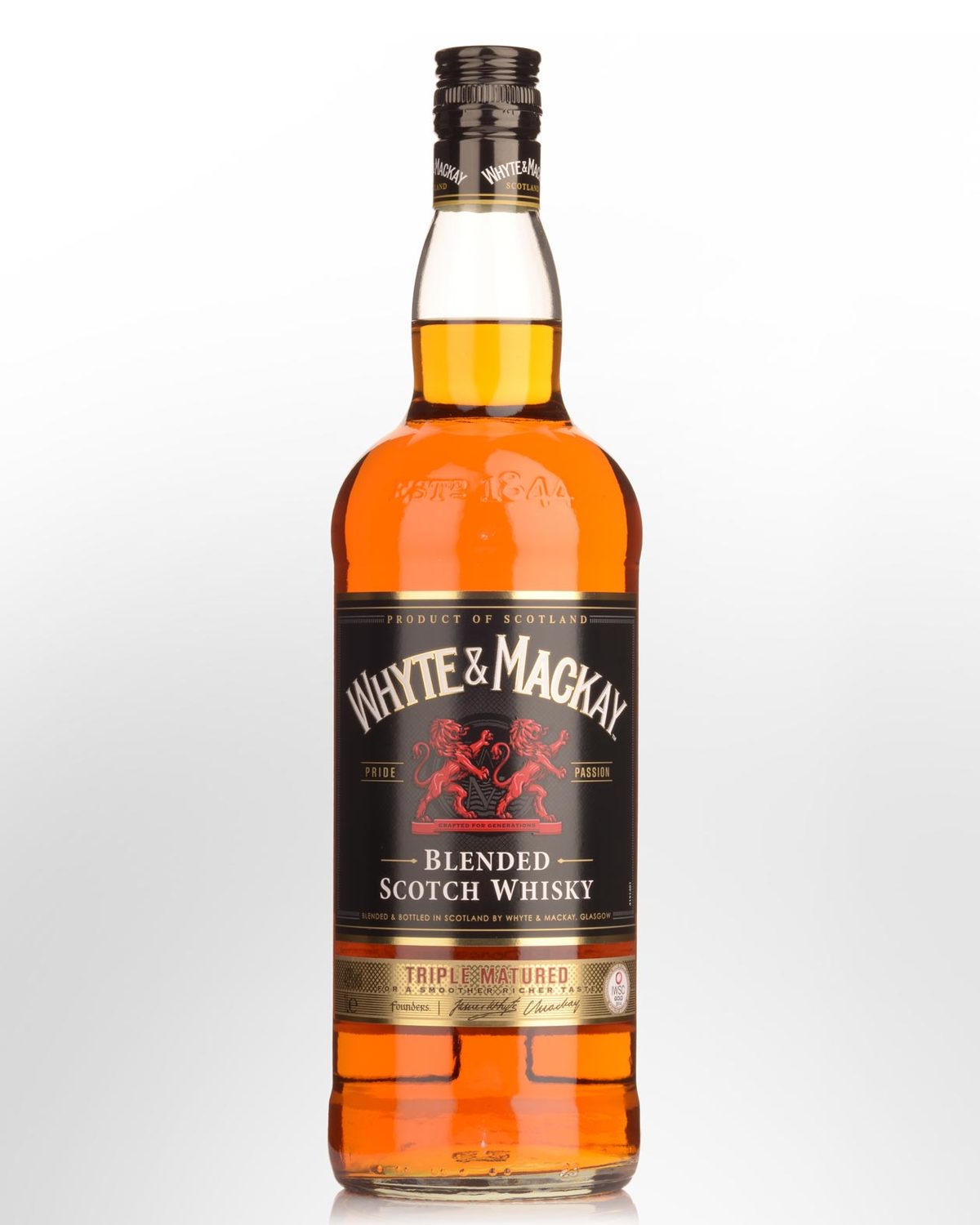
Whyte & Mackay Blended Scotch Whisky (1000ml)SCOTLAND$84. 99Bottle$1019.88 DozenABV: 40%Tasting note: Composed from 41 different whiskies and "Triple Matured" for extra character with a finishing in Sherry casks, this deep amber coloured blend suggests a good proportion of malt is in the mix. Medium bodied and with enough substance to enjoy on its own, it finishes on a sherried note with flavours of spiced raisin cake and stewed plum. Sweet grains play second fiddle. 40% Alc./Vol. Other reviews... If you're looking for a big flavoured dram and with something approaching a vicious left uppercut, this might be a useful bottle to have on hand. ..a veritable orgy of big, oily, juicy, murky flavours...You cannot but like it, in the same way you might occasionally like rough sex.
84.5 points - Jim Murrays Whisky Bible 2017 Gold 2014 San Francisco World Spirits Competition.![154454544_1.jpg]()
- 94
- 95
- Nicks Import
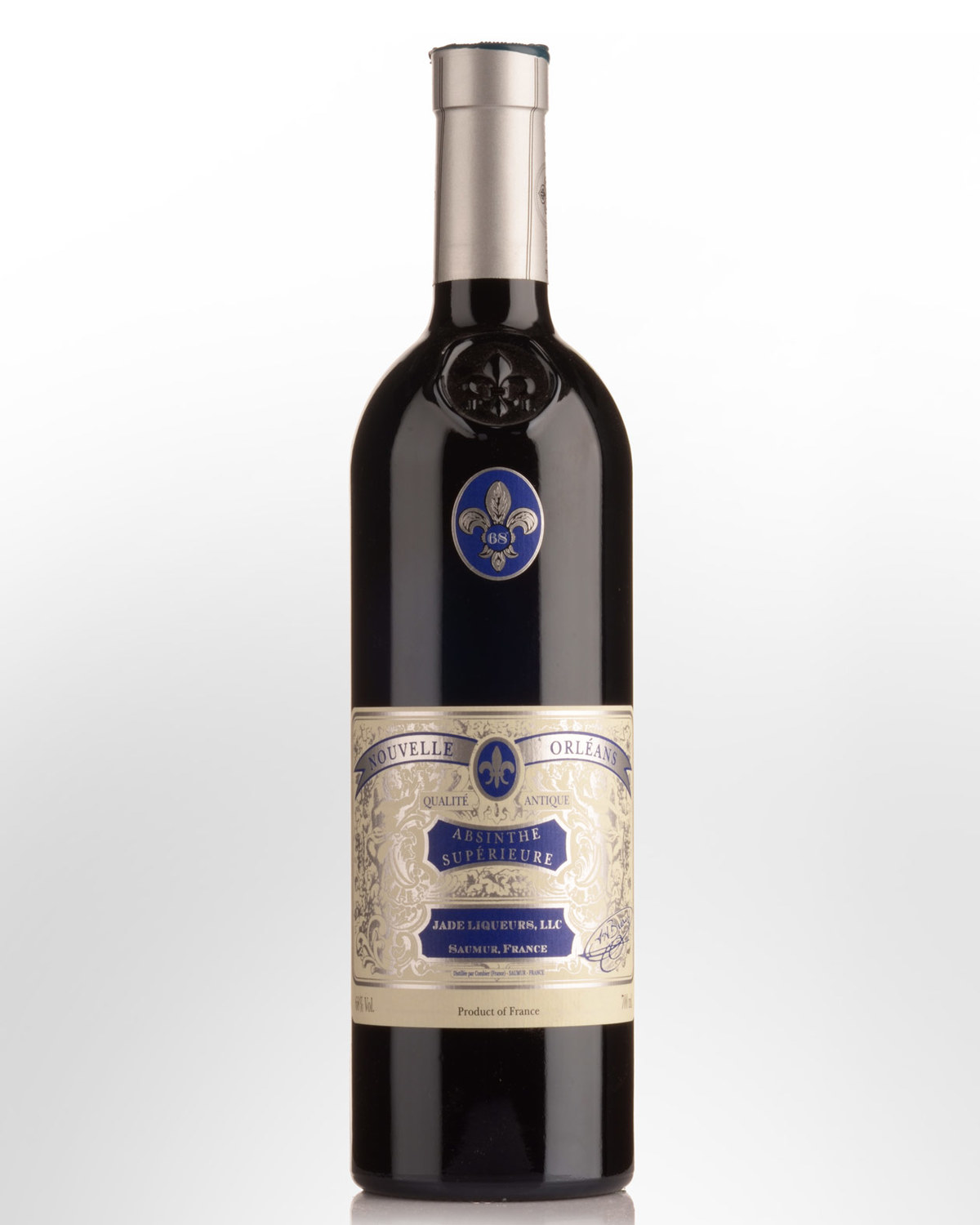
Jade Nouvelle Orleans Absinthe (700ml)Saumur, Loire Valley, FRANCE$199. 99Bottle$2399.88 DozenABV: 68%As the popularity of absinthe swept through France during the mid 19th century, la fée verte began making her way over to the 'Paris' of the New World, La Nouvelle-Orléans (New Orleans). French-speaking travelers and immigrants alike carried their taste for absinthe to this vibrant port city, and before long, French apothecary Antoine Peychaud was doling out 'healthy' absinthe-laced elixirs from his Royal St. shop. The popularity of absinthe surged in French-speaking Louisiana, and when Henri Degas and Oscar Wilde arrived in New Orleans in the latter part of the 1800s, they had no trouble finding imported French and Swiss absinthes among familiar comforts. By the advent of the 20th century, cafés like the famous Old Absinthe House were making a name for themselves by cooling the humid summers with sazeracs, absinthe frappés, and even the occasional absinthe crème de glace. Unfortunately, it all came to a halt with the U.S. ban on absinthe in 1912 ... or did it?
Those already in the know will be familiar with Ted Breaux, a biochemist and researcher who grew up in New Orleans. Ted rose to fame when he cracked the “Absinthe code” in the late 1990s, employing gas chromatography to analyse an old sample. Ted subsequently set up a business, ‘Jade Liqueurs’, with the aim of recreating several ‘rediscovered’ Absinthes. Jade "Nouvelle Orleans" represents the inspired work of this native New Orleanian. The heritage of both the drink and its creator are rooted in the original absinthes that made the sazerac cocktail and absinthe frappé famous.
Nouvelle Orleans presents with a pretty bright turquoise / emerald green and offers a dense, lifted, complex bouquet. Initial sniffs suggest fresh liquorice strap, becoming more herbaceous with hints of fennel, sawn cedar, chamomile tea and curry leaf. Despite the undeniable intensity, there's a sense of delicacy - this feels like it evaporates from the tongue. Anise and dried fennel lead the attack. Concludes ethereal, cleansing, pleasantly bitter; liquorice root and aniseed lingering through the aftertaste. Once again, amazingly balanced given the extraordinary ABV. 68% Alc./Vol.
Other reviews... Grab your corkscrew to open a bottle of this absinthe, a tribute to distiller T.A. Breaux's hometown, New Orleans. The light jade liquid louches to cloudy pale green, releasing gentle fennel, rosemary and fresh basil accented with lime zest and white pepper, plus a long, gentle anise finish. Although it's easy-sipping when louched, the undiluted spirit is ideal for prepping a glass to receive a sazerac. 95 points - wineenthusiast.com
![4504500022_1.jpg]()
- 96
- Nicks Import
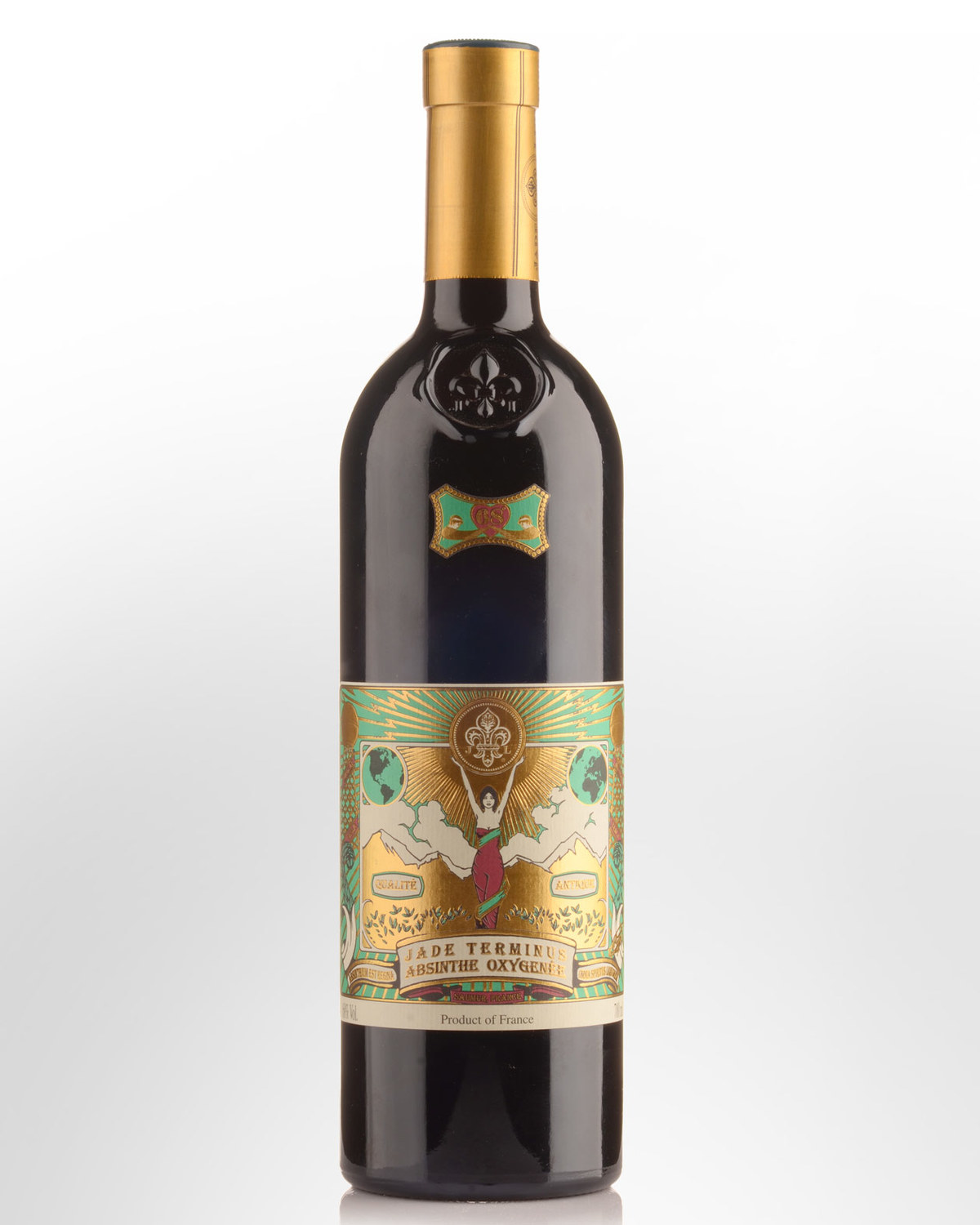
Jade Terminus Oxygenee Absinthe (700ml)Saumur, Loire Valley, FRANCE$199. 99Bottle$2399.88 DozenABV: 68%The final in a series of historical recreations from contemporary absinthe master, Ted Breaux, produced at the Combier Distillery in France's picturesque Loire Valley. Beautifully presented with a label referencing Nikolai Tesla. The colour is a flawless emerald green. There is something special to the nose; whiffs of fresh alpine air amidst fennel, ripe juniper and anise keynotes; 3-4 minutes in the glass shifts the emphasis, hinting at pine sap, cut grass, lady's handbag, sweet spice and more... Undiluted it's intense, pleasingly bitter-sweet and well rounded with a juicy burst of anise and liquorice. Tingling, bordering on prickly, yet remarkably poised at 68% ABV. The spirit evaporates on the tongue. Ends dry, herbal, fresh, super long and invigorating like a day hike in the Alps. Easily one of the highlights in the current Jade collection. 68% Alc./Vol.
Other reviews... "Absinthe Terminus Oxygénée is the final release in the Jade Absinthe portfolio of historically accurate Absinthes. It is a very special Absinthe, as it plays homage to one of the most interesting Absinthes of the Belle Époque era: Absinthe Oxygénée. This brand separated itself from its peers by a specialized hot oxygenation production process. This treatment was advertised as being “Hygiénique”, because drinking a glass of this Absinthe would not extract oxygen from the blood but rather add oxygen to it, which would have a healing effect on the nerve system, circulation and lungs… In a way, this new production method was a reaction to several scientists and scholars proclaiming that alcohol, and absinthe above all – the scapegoat of the French wine industry – was very dangerous to consumers’ health. Besides being good for your health, this claim was actually also used for advertisement “C´est ma santé” the oxygenation process also lets the Absinthe age very quickly. You can compare it with decanting a wine, allowing oxygen to mix with the molecules of the spirit changing its taste and aroma. The result is a very smooth Absinthe without any alcoholic sharpness. The original brand was the subject of widespread publicity, sold at a premium, and was exported to various ports around the globe. Nevertheless, Cusenier was not the only producer of an oxygenated Absinthe. Premier Fils, another French Absinthe manufacturer also offered an Absinthe Oxygéneé.
Jade Terminus Oxygénée Absinthe Supérieure is artisanally distilled from the same botanicals as the original. The taste is herbal, slightly reminding of medicine due to a healthy dose of a particularly interesting species of wormwood harvested from the foothills of the Alps. True to the original, the final product is also subjected to a hot oxygenation process that closely mirrors the original technique. On the tongue, the Absinthe is creamy, features potent aromatics and a lengthy, stimulating herbal aftertaste. Like all the Jade Absinthes, Terminus Oxygénée is carefully distilled by T. A. Breaux, using the original 19th century Absinthe alembics in the historical Combier distillery. Terminus Oxygénée Absinthe represents the most powerful expression of the spirits in the Jade portfolio." - www.alandia.de/
![804773_1.jpg]()
- 96
- 97
- 97
- 94
- Nicks Import
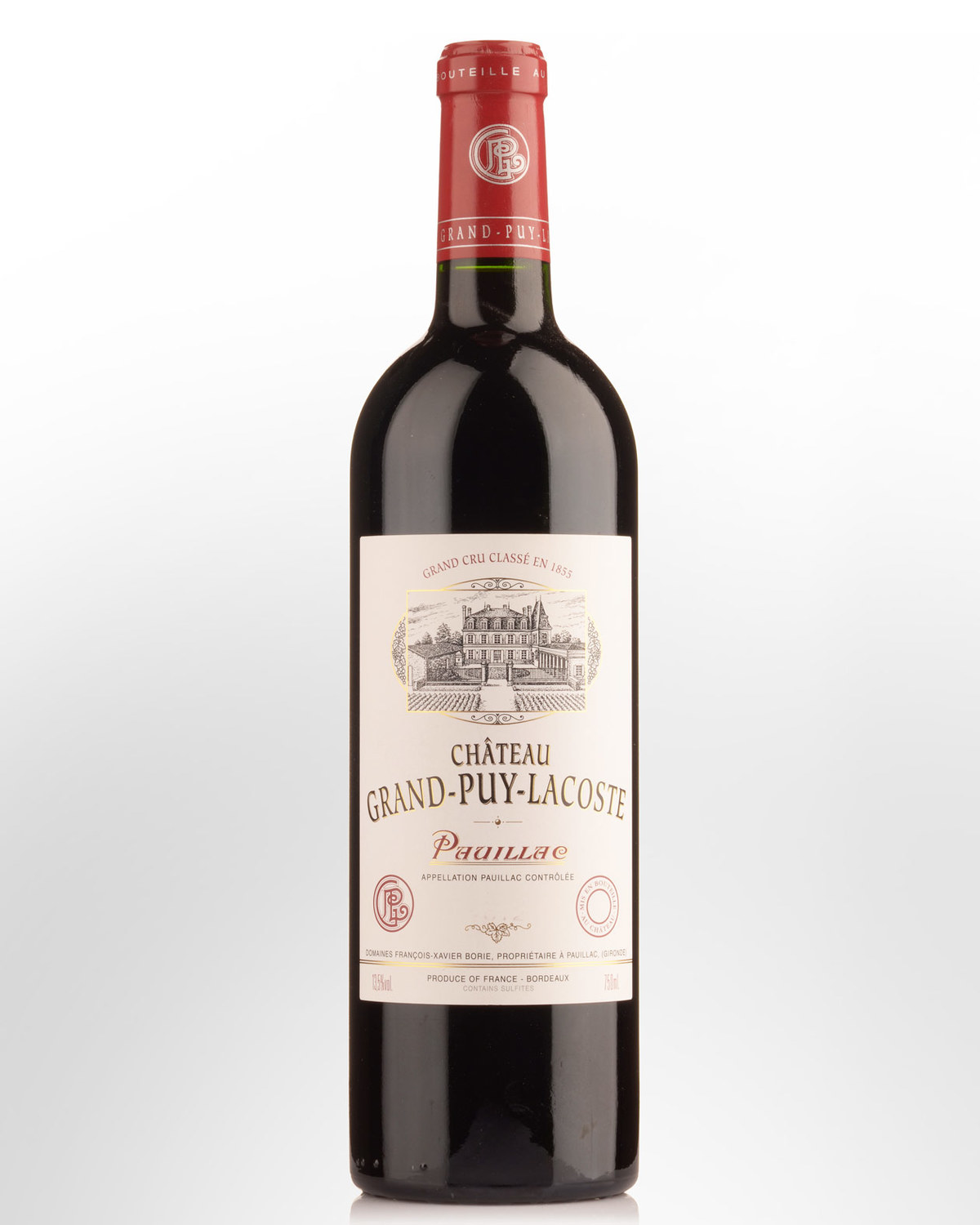
2016 Chateau Grand Puy LacostePauillac, Bordeaux, FRANCE$260. 00Bottle$3120.00 DozenClosure: CorkA truly classic, age worthy style of wine from Pauillac, Chateau Grand-Puy-Lacoste is one of those Fifth Growth wines that shine in great years, rivalling the very best from the region. This is most recently seen in the pairs of 2009/2010 and 2015/2016. Currently plantings on the 55 hectare estate are 75% Cabernet Sauvignon, 20% Merlot, and 5% Cabernet Franc.
Other Reviews....
The 2016 Grand Puy-Lacoste has a clean, precise bouquet with nicely detailed blackberry, briar and tobacco aromas, touches of mint emerging with time, all utterly charming. The palate is medium-bodied with supple tannins and a fine bead of acidity, conveying a sense of symmetry throughout and leading into a deft, quite persistent finish. This is very classy, and it should age with style. Tasted blind at the Southwold tasting. Drink 2023-2055.
97 points
Neal Martin - Vinous (Jan 2020)A neoclassical edition of Grand-Puy-Lacoste, this has cedar, graphite, deeply integrated cedar and spicy-oak influence and a very fresh array of ripe blackberries, dark cherries and cassis. The palate is so seamless. It builds beautifully and delivers a long, seamless array of perfectly ripe dark fruit, swathed in fine, firm, ascending layers of tannins. As good as we have seen in recent vintages, this is a star of the vintage. Try from 2024.
97 points
James Suckling (Jan 2019)The deep garnet-purple colored 2016 Grand-Puy-Lacoste gives up pure kirsch and red and black currants with violets and baking spices. Medium-bodied, firm and grainy, it's very expressive with good concentration and length. Drink 2021-2039.
94+ points
Lisa Perrotti-Brown - Robert Parker's Wine Advocate (Dec 2018)A Pauillac fifth growth estate with a strong reputation for outperforming its classification, Grand-Puy-Lacoste remains family-owned and run by François-Xavier Borie. The estate’s 58ha of vines in production are located on deep gravel soils. The 2016 is a blend of 79% Cabernet Sauvignon and 21% Merlot, vinified in stainless steel and aged for 18 months in French oak barrels (75% new). Georgie Hindle: Aromatic and forward. Lively, powerful, firm with plentiful tannins. Cherry, cranberry and ripe plum. Lashings of liquorice, cola and mint. Not overly spiced but still quite tight. Vincenzo Arnese: Elegant nose, very floral, hints of roses. Integrated sweet spice. The palate is fresh, with good structure. Nicely balanced. Robert Mathias MW: A Pauillac of great poise. A strong mineral inflection, with kelp and iodine notes that accentuate the ripe, dark berry fruit. Hints of black tea and cocoa. Very fine. Drink 2025-2038.
96 points
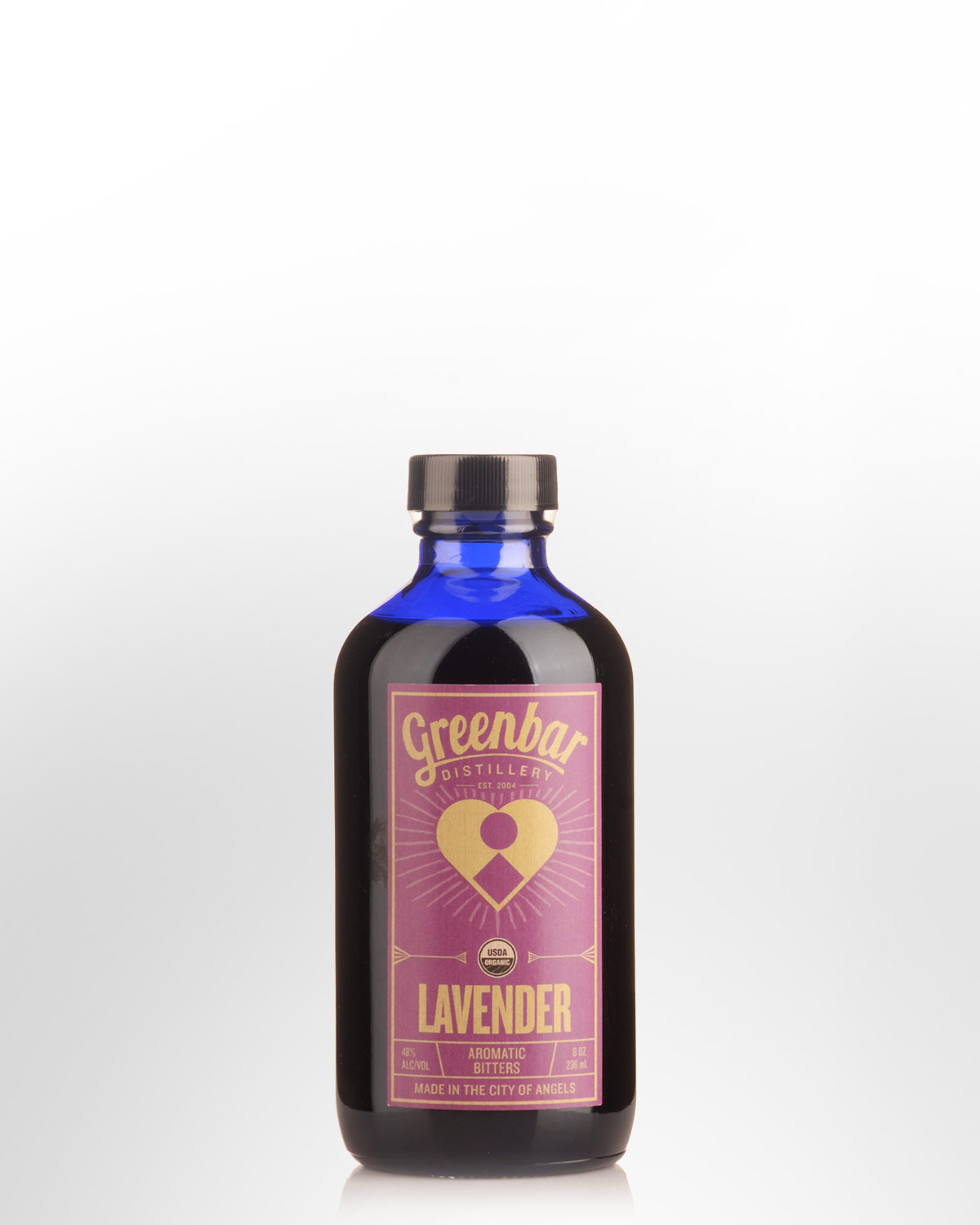
Panel tasting - Decanter (Apr 2025)![Greenbar Lavender Bitters (236ml)]() Greenbar Lavender Bitters (236ml)California, UNITED STATES$32. 99Bottle$395.88 DozenABV: 48%
Greenbar Lavender Bitters (236ml)California, UNITED STATES$32. 99Bottle$395.88 DozenABV: 48%Tobin Ellis & John Hogan's Lavender Spice recipe balances fresh lavender's floral yet deeply masculine nature. It's an ideal partner for gin and other white spirit drinks. 48% Alc./Vol.
![5665015610_1.jpg]()
- Nicks Import
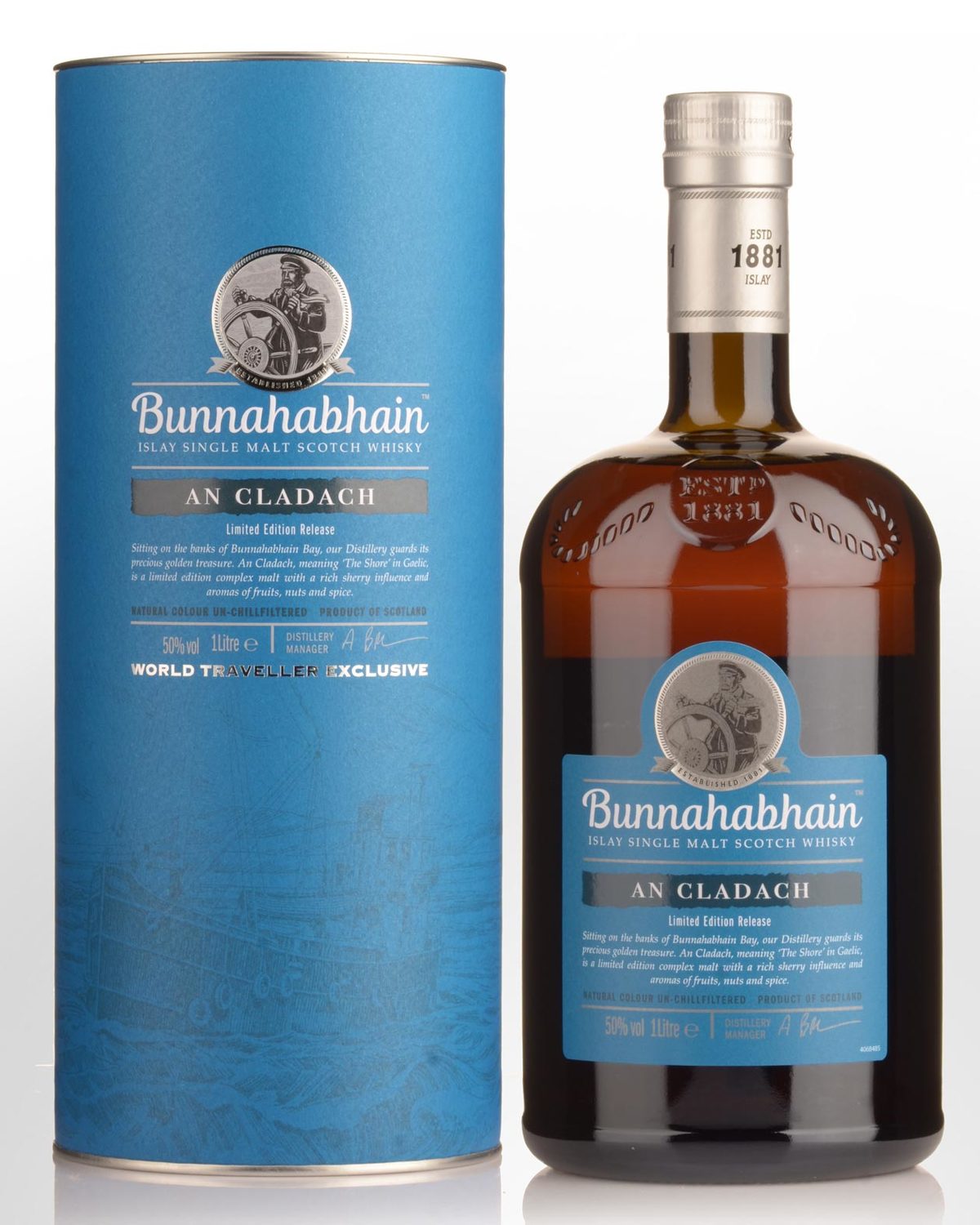
Bunnahabhain An Cladach Single Malt Scotch Whisky (1000ml)Islay, SCOTLAND$149. 99Bottle$1799.88 DozenABV: 50%This is the third Bunnah' Travel Exclusive following Eirigh Na Greine and Cruach Mhona. Released in August 2017, An Cladach, meaning "The Shore" comes aged in sherry casks and bottled at high ABV.![Amrut Intermediate Sherry Matured Cask Strength Single Malt Indian Whisky (700ml)]()
- 97
- 96
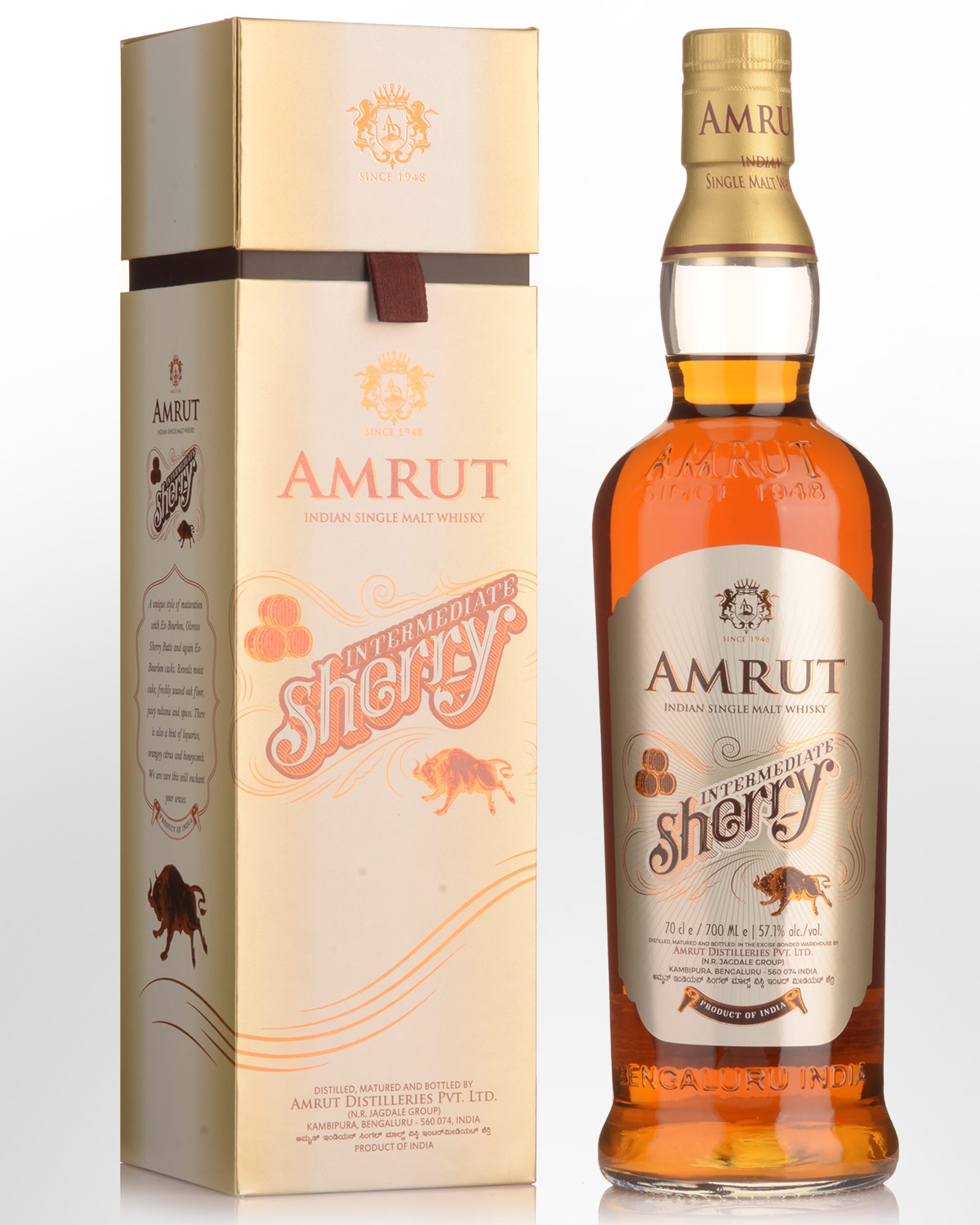
Amrut Intermediate Sherry Matured Cask Strength Single Malt Indian Whisky (700ml)Bangalore, INDIA$220. 00Bottle$2640.00 DozenABV: 57.1%Note: Slight bruising to the top of the gift box.
Prejudice usually breeds ignorance, and admittedly, there was a time when even we found the idea of a distillery in India entering the domain of luxury spirits implausible. Now seven years on, perhaps more than any other world whisky, Amrut has changed the way people think about this category - mostly because the quality is simply impossible to ignore. The best examples from this distillery surpass your expectations at every level.
We'd been following the development of Amrut through the tasting notes of Jim Murray for some time, as the 2007 bottling earned 89 points with the closing statement "as 40% abv malts go - from any country - this is pretty spot on." In 2008 Amrut increased the ABV to 46% and much to Murray's delight ceased the use of caramel colouring, subsequently the whisky earned 91.5 points to cap off a salivating review. Amrut had our attention.
A selection of cask strength expressions have recently become available for Australian whisky enthusiasts, and the quality is first rate, to the extent that these stand out as bargains on the world whisky stage. They are a revelation to almost anyone who tastes them.
The present situation we're witnessing in India is in some ways akin to the early Japanese whisky industry. It remains a work in progress, and there are good reasons why it's taken decades to get this far.
"You have seen and understand India," a local observed to one visitor who recently toured Amrut. "We need grain to feed people. Whisky is not important and rightly it's not a priority. We use what we have."
He was indirectly referring to the vague and permissive laws which historically, saw almost 90% of Indian spirit produced from molasses. Blended malt styles often contained as little as 4% actual malt whisky. When Amrut was originally established in 1948 under the name of "Amrut Laboratories", it produced "rum" & "brandy" during the 50's and 60's. India was a huge market, but primarily at the lower end. Post-independence and with the liberalisation of licensing laws, Amrut's founder, Radhakrishna N. Jagdale, sensed an opportunity. “This is when he diversified into Amrut Distilleries, while also continuing with a division in the pharma industry,”recollects son, Jagdale who initiated the production of malt whisky during the 1980s.Amrut turned the traditional Indian approach on its head. "We understood the importance and complex chemistry of [barrel] maturation, thanks to our chemists’ background,” adds Jagdale. They near perfected the production process, ironically, with guidance from the Scots.
But the company faced difficulties convincing consumers to try the product. Most believed that a good single malt could not be produced in India. To deal with the understandable prejudice, the company's early strategy targeted international markets, that would then, in theory, go on to ignite local demand given positive feedback. "We were confident of our single malt. From a marketing perspective, we thought if our product had to pass the test, why not do so in the toughest location. Scotland is the home of Scotch. If they acknowledge our single malt, then that’s good enough for me"said Jagdale. The group debuted its piece de resistance, Amrut Indian Single Malt, in Glasgow in 2004.
"It was all worth it", recalls executive director of the company, Jagdale Junior, "... We had our jaw-dropping moment when the host at Glasgow's famous Pot Still whisky pub served Amrut to a group of connoisseurs, without telling them where it was from. Each person named a different region of Scotland as the likely place of origin, but they were unanimous in their appreciation."
By the time Amrut launched in India in 2010, they were already selling fifteen variants of single malt to leading world retailers (Harrods, Selfridges across the UK,and Park Avenue Liquor Shop in New York, to name a few). It was risk that paid dividends on the brand's home ground.
Amrut is situated in Bangalore, India, 3000 ft above sea level with the water and barley being sourced from Punjab and Pajasthan. Though the maturation takes place high up above the city, hot weather makes whisky mature faster in India than it does in Europe or the United States. The fraction lost to evaporation during ageing, known as the angels' share, is also higher in India, at 11–12%, as opposed to Scotland, where the annual evaporative loss is about 2%. Most Amrut whiskies are reportedly less than 6 years old, yet a steady stream of awards have been left in their wake. The company is now in the envious position of keeping up with demand, without compromising their down to earth philosophy of always exceeding customer expectations. (Is their any other formula to successfully break into new markets?)
Fusion and Portonova remain the most popular whiskies in the portfolio. But at around 10,000 cases of malt whisky per year, Amrut is a relatively minor player. Demand from over 22 countries means allocations remain small. That may change. Let's hope the staggering quality currently on offer does not.
"Intermediate" is created by initially maturing Amrut spirit in a combination of ex-bourbon and new American oak casks, followed by a brief maturation in sherry casks before returning to ex-bourbon casks for its final stint - hence the name 'Intermediate Sherry'. No shortage of rave reviews, including a whopping 96.5 point score from Jim Murray. We have to agree on this one.
A full throttle, sherry-bourbon extravaganza!
Tasting note: Deep copper. Is this Sherry or Whisky?! Stunning purity in the complex, wound up layers of orange rind and fruit cake - even nutty, rancio like qualities - as close as you can get to an old-style Sherry bomb sans sulphur. Sensory magic as this continues to unravel a dense sweet core and the subtle spices add further complexity (cardomom / wasabi?) Creamy satiny entry introduces a barely bittersweet mid palate with a superbly balanced amalgam of dried fruit; Juicy raisin cake enters late followed by a drying, spicy finale that goes on and on...Fig cake and walnut laced vanilla carry the fade. A triumph. If you buy top shelf Sherried malt at two or three times the price but ignore this we don't know what to say. Undeniably a bargain on the world whisky stage.57.1% Alc./Vol.
Other reviews...96.5 Points - (n24.5); (t24); (f23.5); (b24.5) how do you get three freshly emptied oloroso butts from Jerez to Bangalore without the casks spoiling, and not use sulphur? Answer: empty two cases of Amrut cask strength whisky into each of the butts before shipping them. Not a single off note. No bitterness whatsoever. And the fruit is left to impart its extraordinary riches on a malt matured also in American Oak. Amrut is spoiling us again. - Jim Murray's Whisky Bible 2013
![90809022_1.jpg]() Nikka Rare Old Super Blended Japanese Whisky (700ml)JAPAN$109. 99Bottle$1319.88 DozenABV: 43%
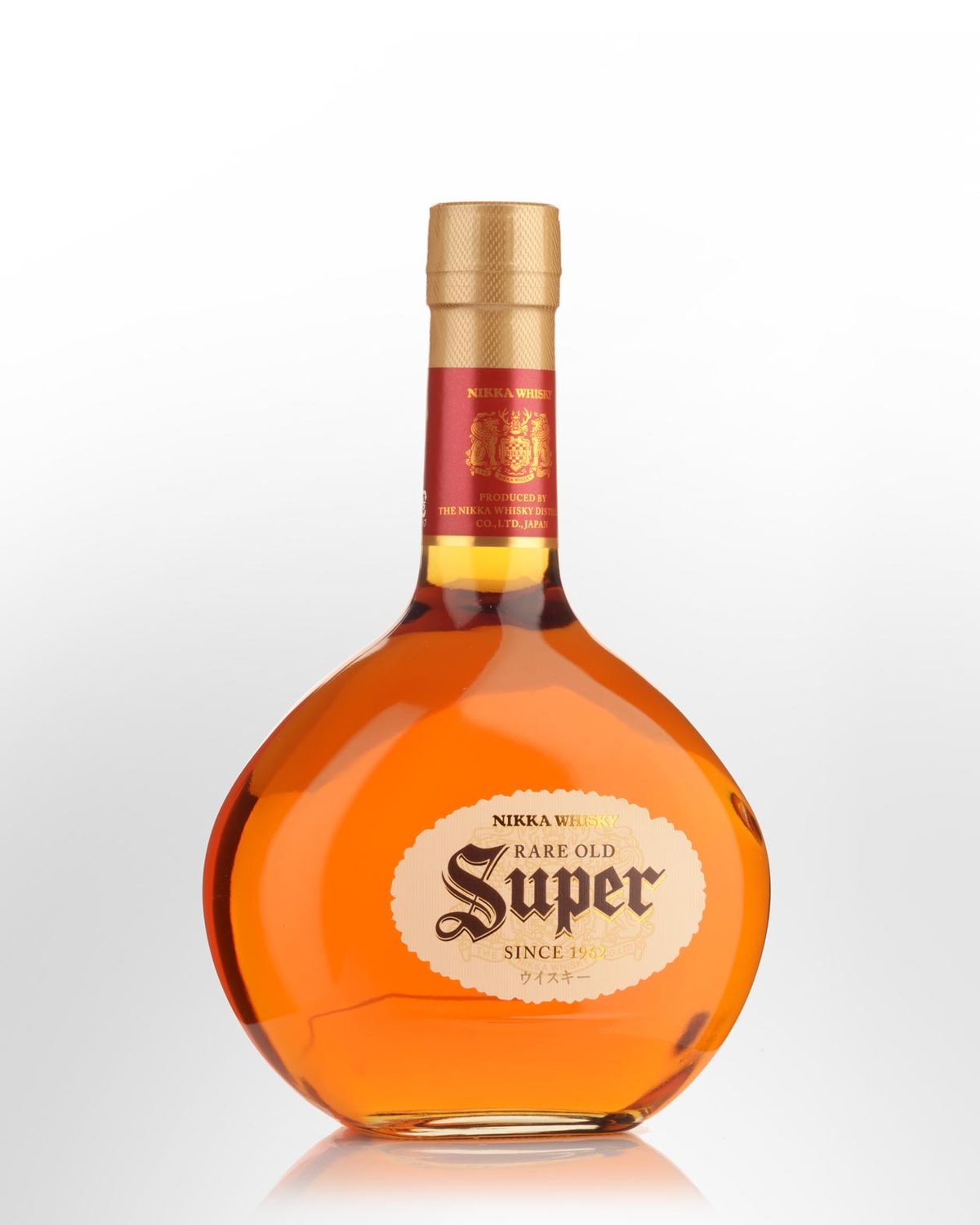
Nikka Rare Old Super Blended Japanese Whisky (700ml)JAPAN$109. 99Bottle$1319.88 DozenABV: 43%World Whisky Awards Category Winner for Best Japanese Blend in 2015. A long time best seller for Nikka and one of the company's classic brands, but almost never seen in Australia, the Super Nikka was introduced to the market in 1962. Despite being classified as a blend, it's reported to contain a high proportion of malt from the Yoichi and Miyagikyo distilleries. Other reviews... Beautiful whisky which just sings a lilting malty refrain.
90.5 points - Jim Murray's Whisky Bible 2013 Quite youthful aromas of citrus fruit, sherry wood spices and a touch of smoke. The palate is mellow with some citrus and plenty of sherry wood spices. Quite balanced with a good citrus complexity and a slightly smoky finish. Water brings out a floral orange Muscat note, whilst on the palate it brings out some vanilla nuances. - World Whisky Awards Category Winner 2015 "Opulent and gently peaty with the essence of aged sherry casks, this whisky goes down smooth with a well-rounded and balanced flavor" - ISC 2008 Gold Medal winner.![Bruichladdich Octomore Edition 6.1 Cask Strength Single Malt Scotch Whisky (700ml)]()
- 96
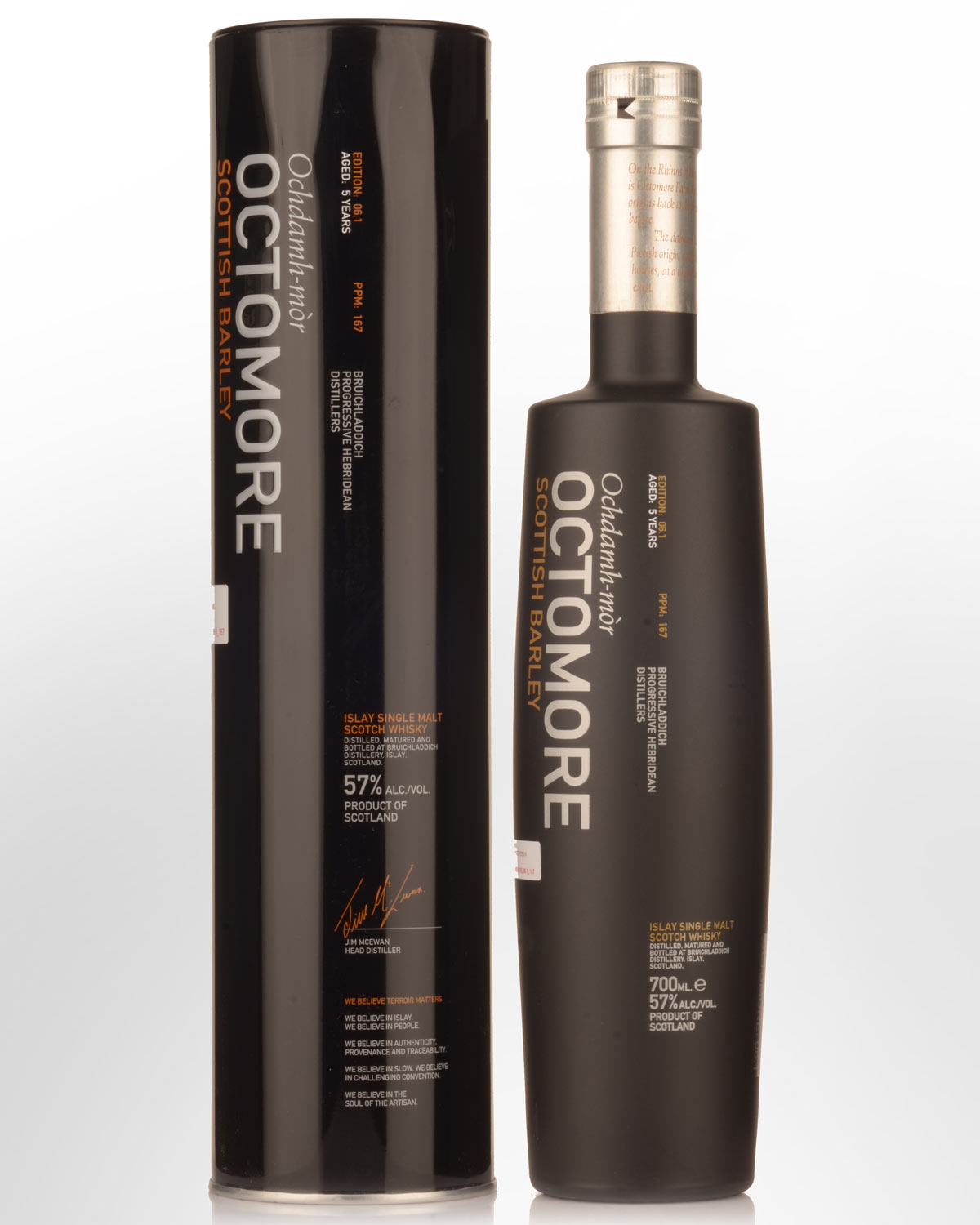
Bruichladdich Octomore Edition 6.1 Cask Strength Single Malt Scotch Whisky (700ml)Islay, SCOTLAND$599. 00Bottle$7188.00 DozenABV: 57%Note: Product has come from a private collection and as such has some minor scuffing/scratches/handling marks. Actual product pictured.
Wholly matured in American oak, 'Octomore' takes its name from a farm two miles away from the distillery (where all of the barley used to create this edition was sourced). In its sixth release, peated to a whopping 167 phenol parts per million - this series remains one of the smokiest efforts on planet earth (Laphroaig and Ardbeg generally weigh in around 40 or 50 ppm) and has garnered a cult following.
Packaged in something akin to a gothic bowling pin from the year 2060, the visual charisma conveys what's inside - think of this as the whisky equivalent of Pink Floyd when Syd Barret still mattered - whimsical, progressive and 'out there’: Islay in interstellar overdrive.Tasting note: Brilliant deep gold, polished brass colour. Wavers for a minute before a more definitive peat-reek profile of lanolin / wool shed and manure takes centre stage. The walk through the farmyard continues into the second pass which adds jaffa, choc fudge and dense fruit'n'nut chocolate interchanging with dried grass-like notes through the earthy peat. Final inspection finds orange cake and sweet cereals now to the fore while the overall bouquet drops a notch intensity wise. Five years old, 167ppm and cask strength yet so accessible that there's even an ethereal sense of 'lightness' (relatively speaking) that sets this apart from the previous release. The alcohol just gently nips at the tongue as cocoa and vanilla rise through the smoke along with flashes of grassy / grain flavours. Weighty peat slams down to finish. Incredible balance. Ends creamy as hints of cocoa, vanilla and sooty lanolin repeat in the prolonged fade. So easy to drink it should come with a warning label. But is it more than just a peat bomb? Brace yourself for something utterly different in the world of Scotch Whisky. 57% Alc./Vol. 96 points
Other reviews...(91.5 points) (n24), (t23), (f22), (b22.5) - Jim Murray's Whisky Bible 2014
...Distilled at Bruichladdich Distillery using only Scottish Barley. Bruichladdich is usually an unpeated brand of single malt but in contrast, at 167ppm, its Octomore alter ego is said to be the world's most heavily peated whisky. Aged 5 years at Bruichladdich’s, this is the sixth edition of Octomore. Appearance: Clear, mid golden amber. Aroma: mouldering embers, vegetal peat, baked apple and smoked streaky bacon. Taste: Honeyed smoky sweetness – strangely reminiscent of mezcal. Vanilla, toasted rye bread, dry nuttiness and poached pear fruitiness with nutmeg and curry leaf spice. Aftertaste: Salty seaweed, streaky bacon and vanilla with lingering oaky nutmeg spice. 4.5 stars - www.diffordsguide.com
![5060244030770_1.jpg]()
- 92
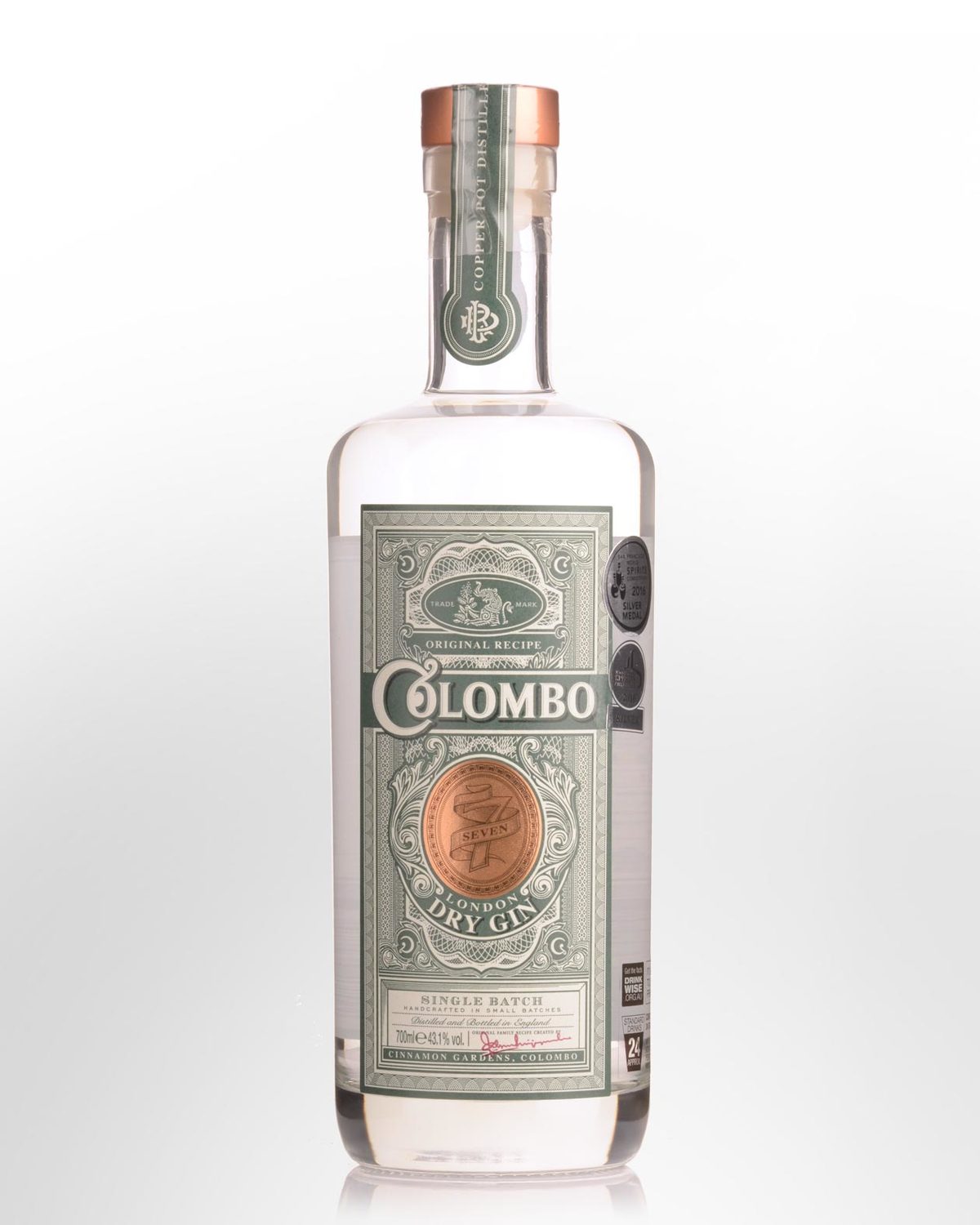
Colombo No.7 Dry Gin (700ml)UNITED KINGDOM$89. 99Bottle$1079.88 DozenABV: 43.1%Based on a 70-year-old-recipe that took Tanqueray No.7 as its inspiration, Colombo No.7 was conceived at a time when many traditional botanicals were difficult to procure due to trade blockades during World War II. Alternatives were found in locally grown cinnamon, ginger and curry leaf. On working on the recreation of the original recipe, the grandson of the founder, Amal de Silva Wijeyeratne commented: “We did try to see if we could enhance it and tried adding other botanicals and spices. We tried lemon grass, turmeric, cardamom etc., but somehow we always found that more spices didn’t necessarily make it better and seemed to take it out of balance." He adds, "My grandfather was always a perfectionist, and Colombo No.7 was already perfect. We didn’t change a thing, and in about two months the gin was ready.”
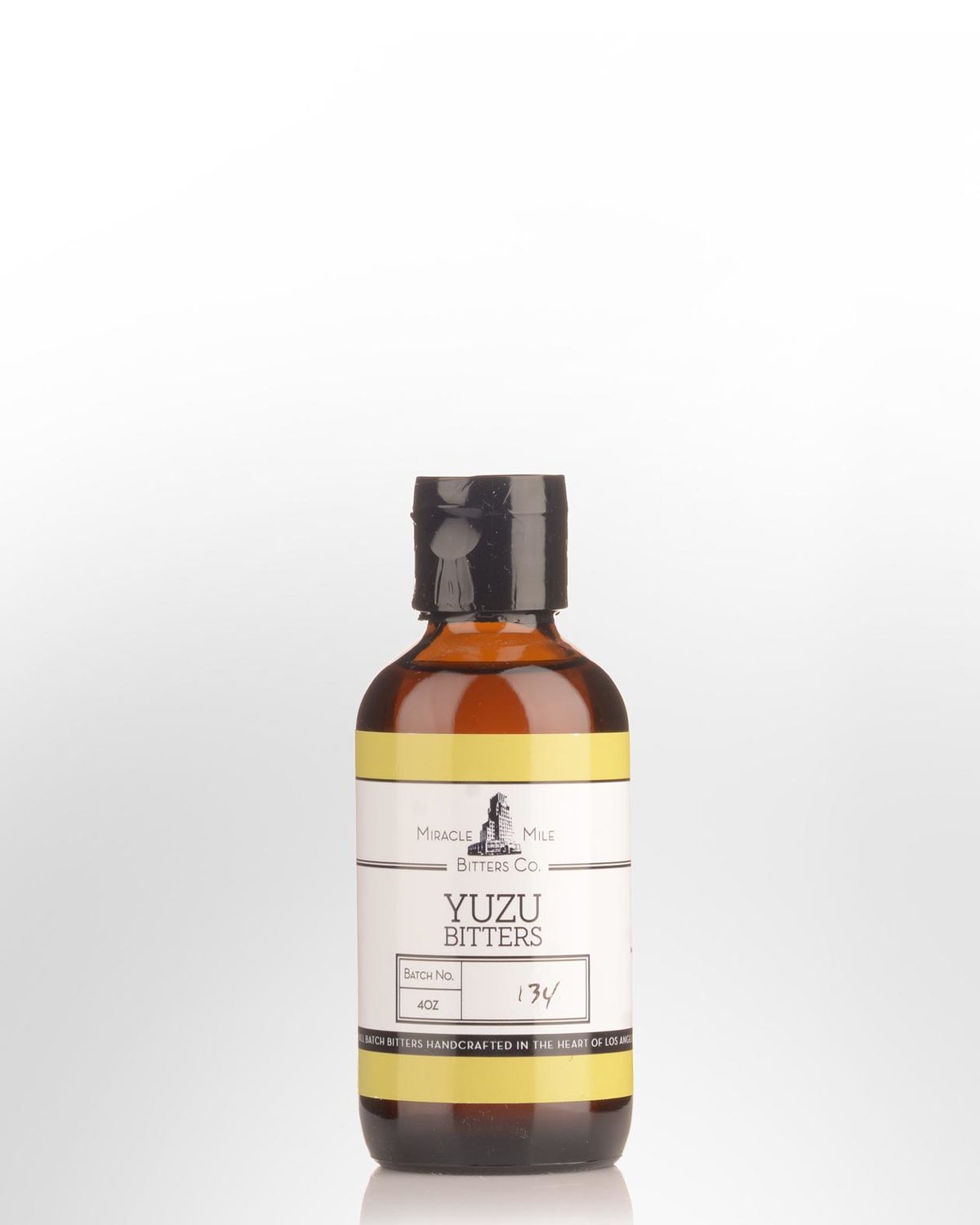
The gin is presently distilled and bottled in England using a 100% grain spirit base. Tasting note: Powerful aromas of pine needle, curry leaf and citrus peel with air contact releasing more of the former. A pure, relaxed delivery with attractive tangy citrus, restrained juniper, white pepper, and a medium long dried herbal finish with trace curry leaf heat in the aftertaste. London dry inspired with a nicely harmonised flavour range. 43.1% Alc./Vol. Other reviews… Colombo No.7 has landed at a funny time in our gin drinking history; when it was first made 70 years ago it would have been unimaginably alien with its citrus absence and curry leaf presence, but tasted next to gins created in the last couple of years it almost cries of tradition. Juniper leads the way to taste, with liquorice and angelica lending an earthy, almost dusty sweetness and a soft mouth. Cinnamon sings loud and bright, though doesn’t whip at the tongue in a typically barbarous manner, instead conspiring with the ginger and curry leaf to bring a fragrant warmth and depth. Coriander seed rounds out the flavour, bringing a hint of citrus and nuts and prolonging the finish. - http://www.ginfoundry.com …Having read the list of botanicals, I was expecting something a bit weird tasting, and possibly over spiced. I am not a fan of cinnamon either. So It was a relief to discover that Colombo No. 7 is a properly balanced gin. Juniper and citrus aromas and flavours abound, followed by subtle cinnamon. The finish has great white pepper notes. In case you were wondering it doesn’t taste of curry! Pretty much a perfect G&T, crisp with juniper and citrus with the curry leaves coming through on the finish. I used their suggested garnish of curry leaves which was delicious, but there are plenty of other garnishes that could work well like ginger, lime or mango… - theginqueen.com Silver medal – San Francisco World Spirits Competition 2016![5518181081_1.jpg]() Miracle Mile Yuzu Bitters (118ml)California, UNITED STATES$47. 99Bottle$575.88 DozenABV: 45%A variety of Japanese citrus, Yuzu are renowned for their taste and aroma, falling somewhere between a Mandarin and a Grapefruit. Yuzu Bitters are a wonderful companion to drinks that lean toward the floral, citrus, herbal, and sweet side of things. The citrusy notes are combined with traditional bitters ingredients such as Cinchona, Cardamom, and Burdock Root, and two kinds of Green Tea to round out the finish. 45% Alc./Vol.
Miracle Mile Yuzu Bitters (118ml)California, UNITED STATES$47. 99Bottle$575.88 DozenABV: 45%A variety of Japanese citrus, Yuzu are renowned for their taste and aroma, falling somewhere between a Mandarin and a Grapefruit. Yuzu Bitters are a wonderful companion to drinks that lean toward the floral, citrus, herbal, and sweet side of things. The citrusy notes are combined with traditional bitters ingredients such as Cinchona, Cardamom, and Burdock Root, and two kinds of Green Tea to round out the finish. 45% Alc./Vol.![1056126_1.jpg]()
- 92
- 89
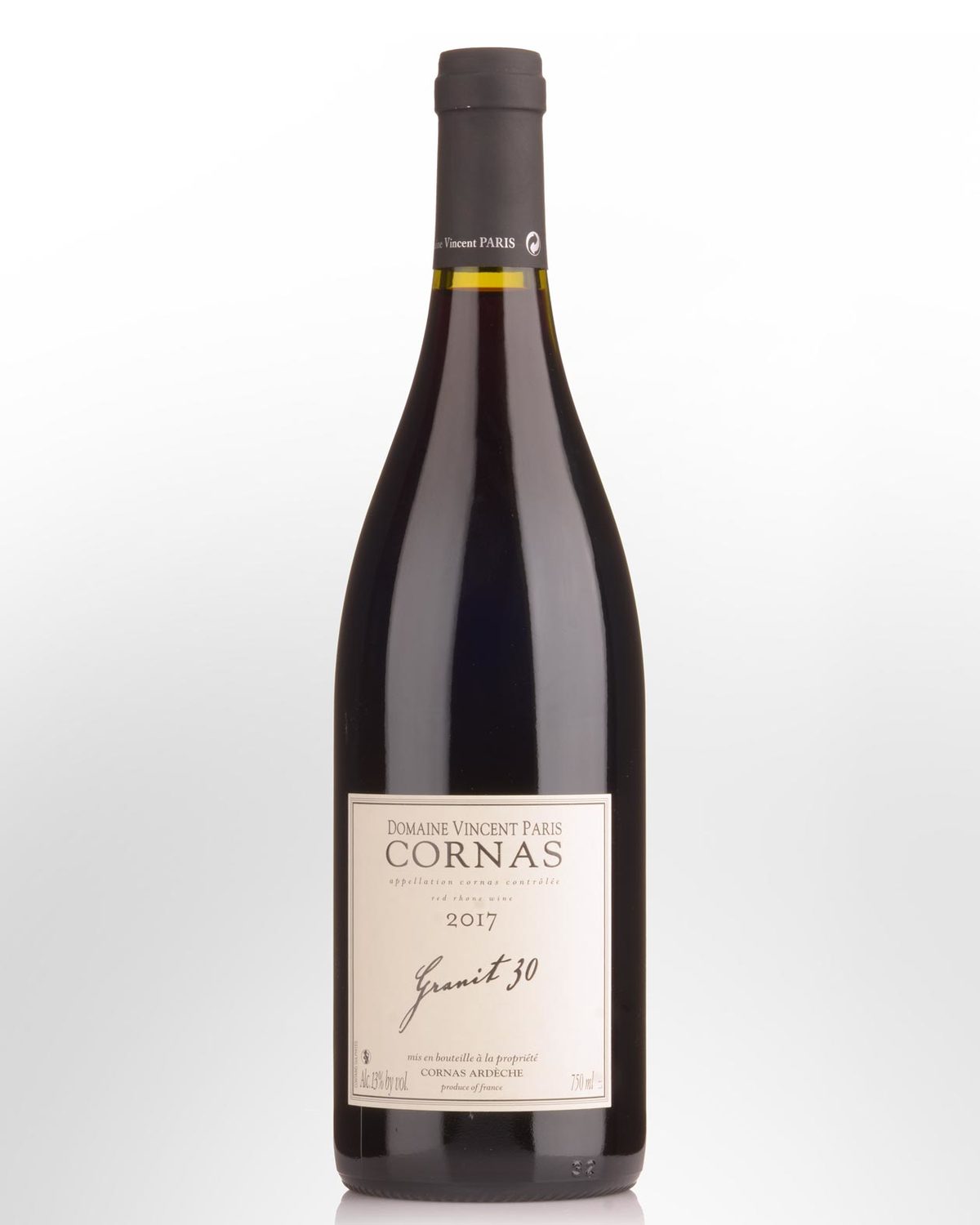
2017 Domaine Vincent Paris Cornas Granit 30Northern Rhone, FRANCE$69. 99Bottle$839.88 DozenABV: 13%Closure: CorkOther Reviews....
Bright purple. Highly perfumed blue fruit, violet and candied licorice aromas show excellent clarity and pick up hints of woodsmoke and menthol as the wine opens up. Juicy and appealingly sweet, offering sappy boysenberry, cherry and spicecake flavors and a touch of smoky bacon. A sexy floral note emerges on the gently tannic finish, which hangs on with strong, spice-tinged persistence.
92 Points
Josh Raynolds - VinousThe 2017 Cornas Granit 30 features flattering aromas of cracked pepper, ground clove, fresh raspberries and crushed stone. But while the wine is full-bodied, it comes across as slightly austere and lacking mid-palate texture, before finishing long, with hints of Berry Zinger tea.
89-91 Points
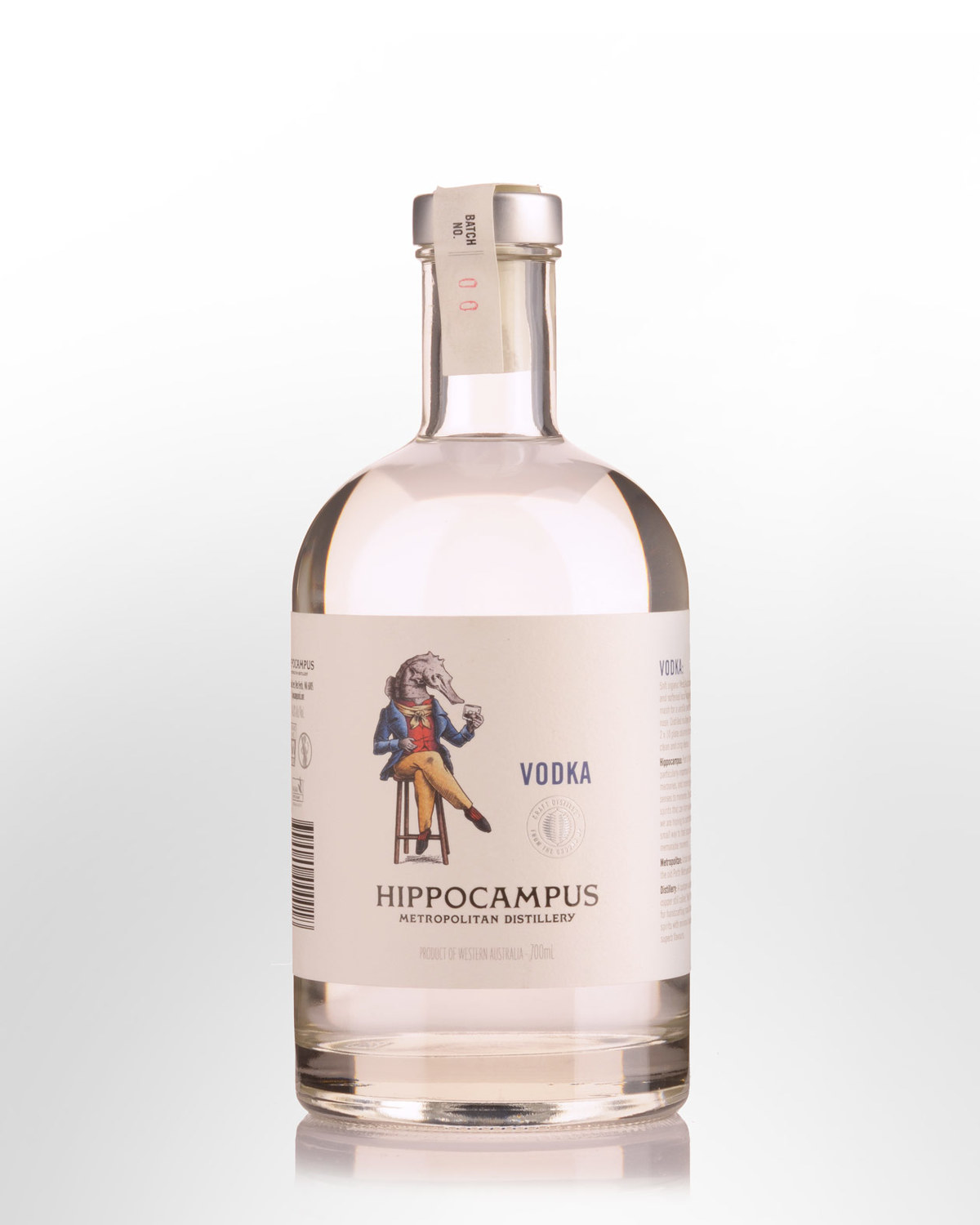
Joe Czerwinski - The Wine Advocate![15612121_1.jpg]() Hippocampus Vodka (700ml)Perth, AUSTRALIA$84. 99Bottle$1019.88 DozenABV: 40%This is Perth-based venture is the brain child of Little Creatures founders and former owners, Nic Trimboli, Howard Cearns and David Martin. The boys comment, "Using biodynamic farmed wheat from Australia's Wheatbelt, fermenting in small tanks using an organic yeast and then distilling in our custom made copper pot still, we have crafted a clean and textured vodka which references our ground of clean skies, healthy farms and the team behind producing it...Flavours of vanilla and fruit shine through with a super smooth mouthfeel from distilling a select number of times... enough to ensure we embrace the soft sweet flavour of the wheat but not too much to strip away this wonderful texture." Not surprisingly, a gin, absinthe, rum and whisky made from WA-sourced ingredients are also planned. 40% Alc./Vol.
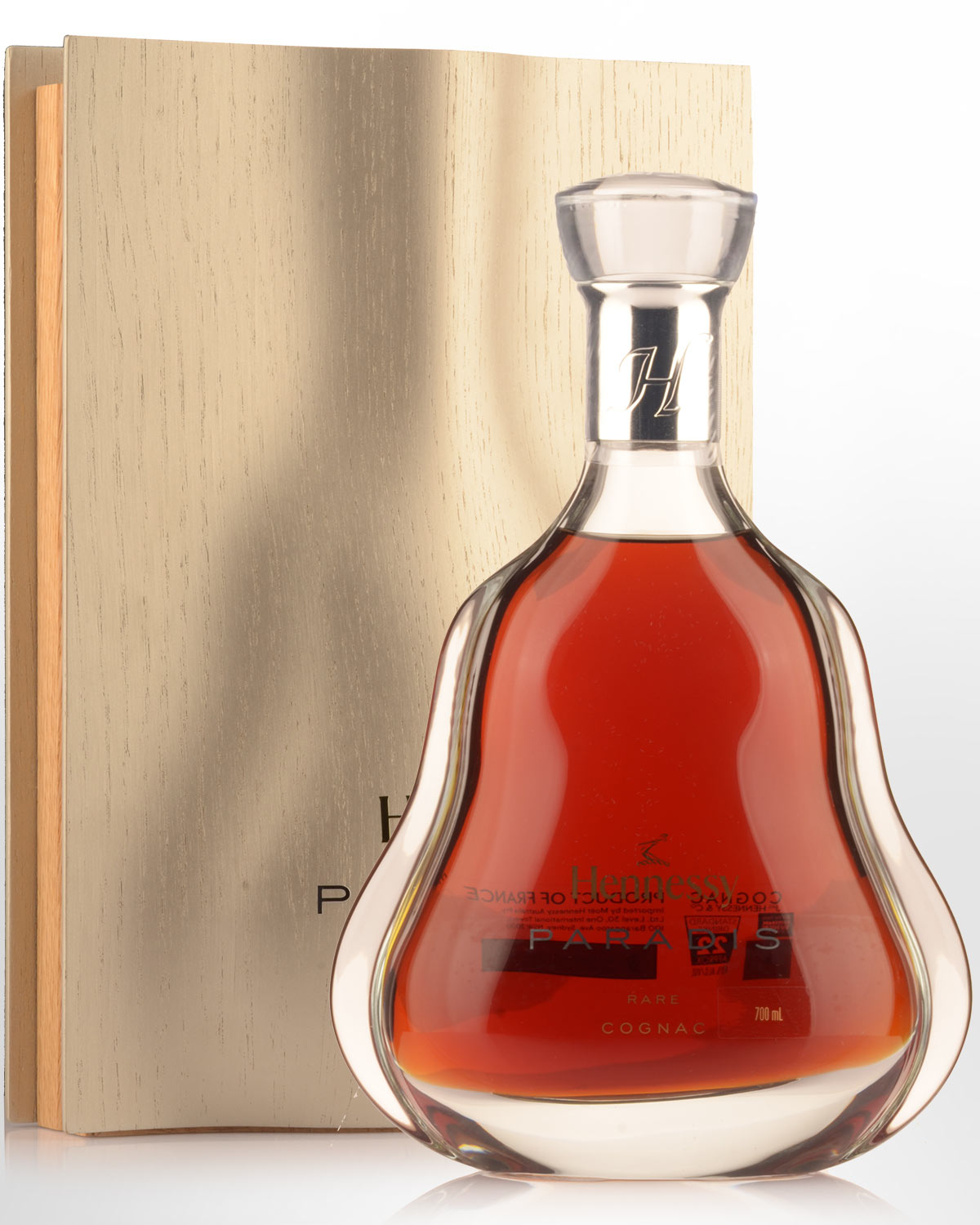
Hippocampus Vodka (700ml)Perth, AUSTRALIA$84. 99Bottle$1019.88 DozenABV: 40%This is Perth-based venture is the brain child of Little Creatures founders and former owners, Nic Trimboli, Howard Cearns and David Martin. The boys comment, "Using biodynamic farmed wheat from Australia's Wheatbelt, fermenting in small tanks using an organic yeast and then distilling in our custom made copper pot still, we have crafted a clean and textured vodka which references our ground of clean skies, healthy farms and the team behind producing it...Flavours of vanilla and fruit shine through with a super smooth mouthfeel from distilling a select number of times... enough to ensure we embrace the soft sweet flavour of the wheat but not too much to strip away this wonderful texture." Not surprisingly, a gin, absinthe, rum and whisky made from WA-sourced ingredients are also planned. 40% Alc./Vol.![Hennessy Paradis Rare Cognac (700ml)]() Hennessy Paradis Rare Cognac (700ml)Cognac, FRANCE$1750. 00Bottle$21000.00 DozenABV: 40%
Hennessy Paradis Rare Cognac (700ml)Cognac, FRANCE$1750. 00Bottle$21000.00 DozenABV: 40%In 1774, Richard Hennessy set up a small warehouse on the right bank of the River Charente to house his rarest eaux de vie, now known as the 'founder’s warehouse.' Since then, eight generations of the Hennessy family have built up what is now the finest collection of old eaux de vie in the world. It is from these that Hennessy has been able to create Paradis Extra. Paradis Extra is the fruit of successive marriages between hundreds of different eaux de vie, nurtured to maturity by successive generations of the same family of cellar masters.
This Cognac is a veritable fireworks display of spices and peppery notes, softened by the fragrant scent of flowers. Finesse and elegance are the major characteristics. Perfectly harmonious in the mouth, Paradis Extra reveals itself to be smooth, full-bodied and long lasting on the palate. Its force and finesse, plus the delicate flavour of rancio, give it a perfect balance. Exceptional cognacs such as Paradis Extra should be enjoyed using tall, thin glasses that narrow slightly towards the top. Such glasses retain the aroma and transmit easily the warmth of the hands to the spirit.
Other reviews.…
The sweet seducer! Colour: Dark walnut with a distinct, deep reddish tinge. Nose: Wood and marshmallows vie for attention with gingerbread and Oolong tea aromas. Palate: Initially sweet, verbena-like aromas become heavy with chocolate, custard apple, slowly turning to mandarin peel, leathery, almost masterstock-like flavours finishing with sweet Pedro Ximenez notes; the finish is long, honeyed and dry, a majestic end to a great Cognac. Comment: The sweetness and balances totally seduces; this would have to be your ‘last wish’ Cognac. 40% Alc./Vol. - tasting note by Franz Scheurer, AGT Wine Magazine, Cognac Tasting 27th May 2005.
A sublime marriage of over 100 eaux-de-vie, some more than a century old. Amber/gold appearance. Textbook tete de cuvee Cognac bouquet of pine needles, clover honey, rancio, sweet oak and spiced apple. Offers elegant flavors of fatty rancio, soft cheese, wood smoke and bacon fat from entry through midpalate. Finishes more woody and resiny than fruity-ripe. Still a favorite after all these years. Gorgeous.
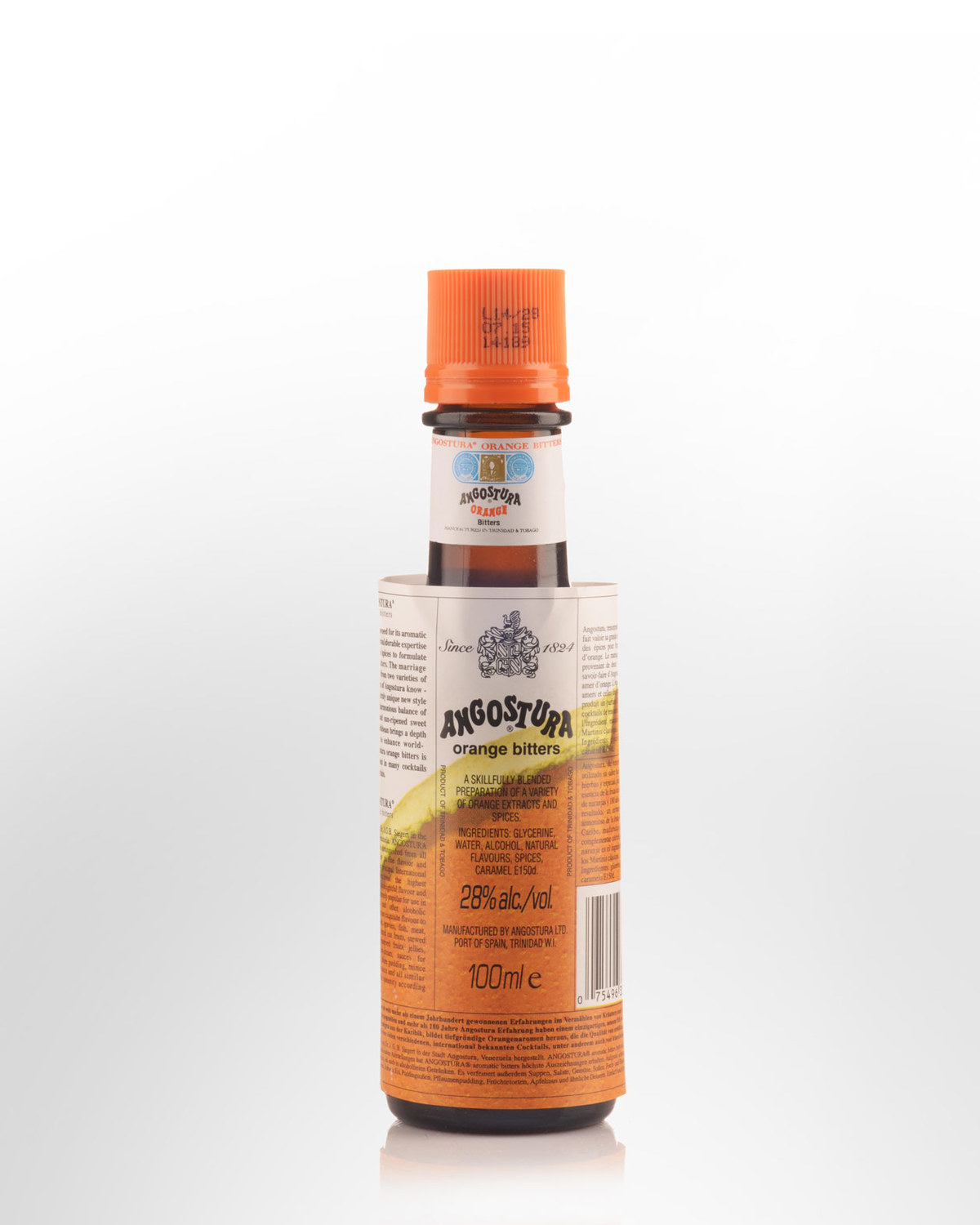
Rating: 90-95 - www.wineenthusiast.com![1020283_1.jpg]() Angostura Orange Bitters (100ml)TRINIDAD AND TOBAGO$20. 99Bottle$251.88 DozenABV: 28%Closure: Cork
Angostura Orange Bitters (100ml)TRINIDAD AND TOBAGO$20. 99Bottle$251.88 DozenABV: 28%Closure: CorkIn the last few years we've witnessed a renaissance period for cocktails and a subsequent demand for traditional ingredients. Many cocktail classics call for Orange Bitters, which for a long time was notoriously difficult to find. With the resurgence of interest has come enough demand to inspire Gary Regan to produce his now famous Regan's No. 6 Orange Bitters. Following Regan's success, others have followed, each putting their own spin on Orange Bitters. Regan's is intense, assertive, extremely bitter and very heavily spiced, Fee Brothers' much lower alcohol version focuses more on capturing the essence of sweet, ripe orange. Angostura's interpretation lies somewhere in between the two. Clean citrus characters are enhanced by a clean spirit, and a balanced dose of spices.
Apart from being an essential addition to classic cocktails such as the Manhattan, Sazerac or San Francisco, we suggest you try a dash in your next martini, with lime and soda, in orange cake or add to Crepe Suzette. One staff member insists a couple of drops is the secret to his self assessed 'stunning' Beef Teriyaki recipe. The jury is still out. 28.0% Alc./Vol.
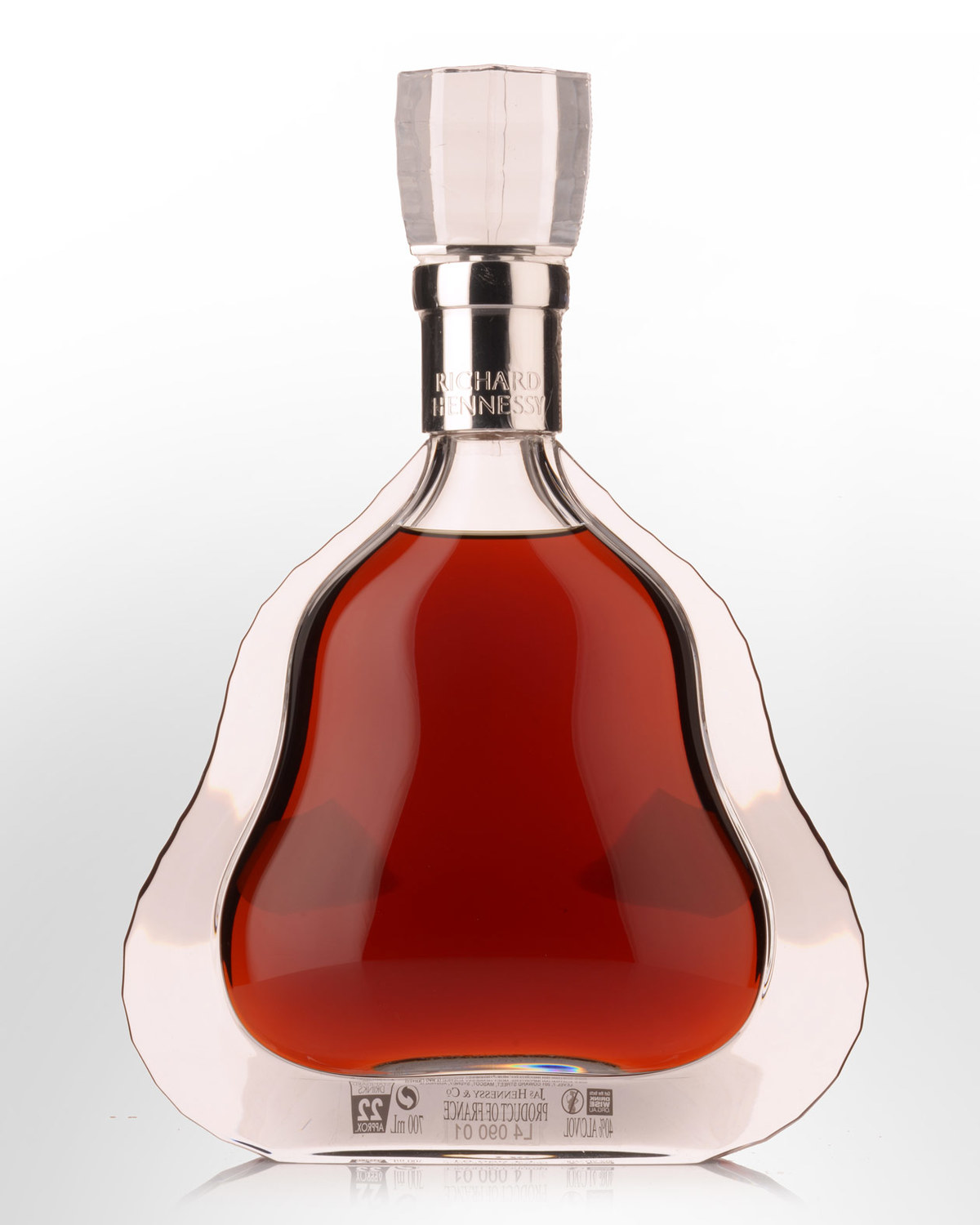
![1027854_1.jpg]() Hennessy Richard Hennessy Cognac (700ml)Cognac, FRANCE$13999. 00Bottle$167988.00 DozenABV: 40%
Hennessy Richard Hennessy Cognac (700ml)Cognac, FRANCE$13999. 00Bottle$167988.00 DozenABV: 40%In 1765, Richard Hennessy laid the foundations of a priceless collection made up of his most exceptional eaux de vie. Since then, eight generations of the Hennessy family have enriched the Founder's warehouse with their own contributions of the finest cognacs produced during their lifetimes. It is from this collection that Hennessy has created Richard Hennessy, as a homage to its founder.
Richard Hennessy is made up of more than 100 of the most exceptional eaux de vie, some of which date from the early 19th century. Each one has been selected for its unique qualities. Balanced and complex, the rich bouquet slowly releases a succession of aromas that have built up over the years: vanilla, spices, pepper and delicately fragrant flowers.In the mouth, the infinitely refined texture reveals an extraordinary palette of flavours that blends spices, the subtle essence of ripe fruit and the finesse of oak.
A tulip-shaped taster’s glass, or a small snifter will warm the spirit and guarantee the gradual but full release of the aromas. According to Talleyrand, celebrated 18th-century French politician and illustrious customer of Hennessy, to enjoy a cognac such as Richard Hennessy one must 'cradle the glass in the palm of one’s hand, swirl the spirit to release its full aroma, lift it to one’s nostrils, inhale deeply and then... set it down and discuss its virtues'.
'Hennessy's pinnacle achievement'.
Other reviews... A blend of over 100 Cognacs, some of which date back to the early 1800s. The aroma requires time; when it does emerge, it blossoms into a multilayered bouquet laced with tea leaves, red pepper, dried fruit and old oak. Starts sweet and caramel-like at entry; sensational midpalate features rancio, raisins, vanilla extract, dried flowers and honey. Finish is semisweet. Hennessy's pinnacle achievement.
Rating: 95-100 CLASSIC. Highest Recommendation. - wineenthusiast.com... A rich man’s Cognac that delivers the goods. Colour: Rich and vibrant mahogany. Nose: A rich melange of vanilla, herby floral and spice notes overshadowed by red roses. Palate: Complex, rich and balanced, no one flavour stands out; it takes on a character of its own, alluring and with flavours that just go on and on; Some detect cherries whilst I revel in the baklava-like oriental, languidly sweet finish. Comment: A connoisseurs Cognac living up to its presentation. 40%Alc./Vol. - Franz Scheurer, AGT Wine Magazine, Cognac Tasting 27th May 2005.
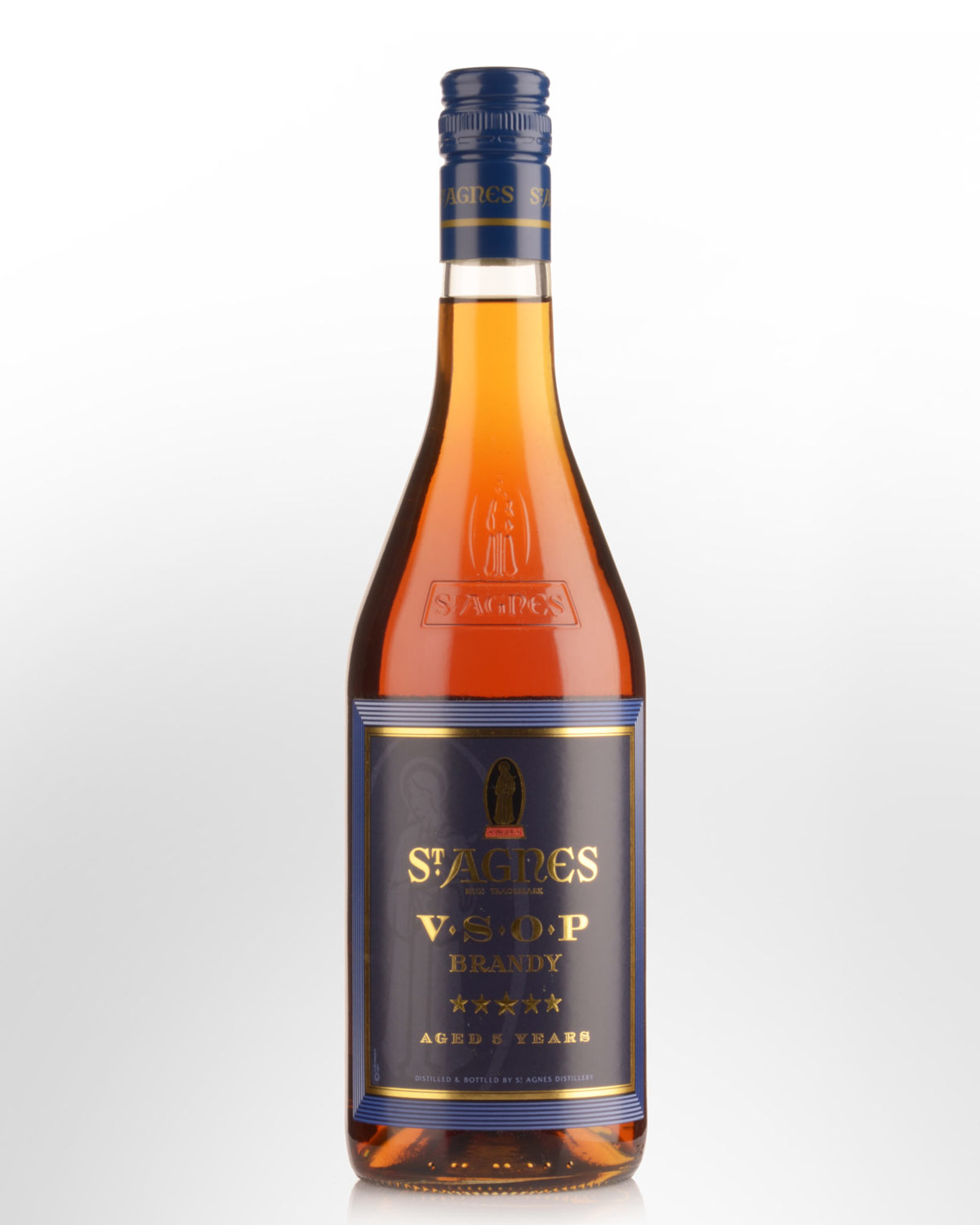
![1010774_1.jpg]() St. Agnes 5 Year Old VSOP Brandy (700ml)Renmark, South Australia, AUSTRALIA$51. 99Bottle$623.88 DozenABV: 37%
St. Agnes 5 Year Old VSOP Brandy (700ml)Renmark, South Australia, AUSTRALIA$51. 99Bottle$623.88 DozenABV: 37%The St. Agnes range of brandies was founded in 1925. Its ever-increasing success in the market-place can, to some degree, be attributed to the no compromise in quality approach adopted since those early days. The company philosophy on brandy production revolves around the pot still process followed by many years maturation in small oak casks. The brandies in the St. Agnes range are all pot still brandies.
St. Agnes VSOP is a richly coloured, full-bodied five year old brandy. The palate shows good spirit with great depth and complexity derived from the extended period of small wood maturation. This ageing has imparted soft, slightly sweet oak after-flavours that complement the full flavoured palate making it discernibly fuller-bodied than its Three Star younger sister. While still made in a clean, dry style, the greater depth and weight on the palate ensures that this fine brandy is as eminently suitable to be enjoyed neat or with a little ice or water, as it is to be consumed with a mixer.
Alc/Vol 37.1%![78954651_1.jpg]() Old Fitzgerald 11 Year Old Bottled in Bond Kentucky Straight Bourbon Whiskey (750ml) - Spring 2018Kentucky, UNITED STATES$1199. 00Bottle$14388.00 DozenABV: 50%Old Fitzgerald's bi-annual releases are differentiated by the colour of the labels and arrive with varying age statements. Each handsome antique replica decanter comes with an old style 'tax strip' that discloses when the bourbon was produced and bottled. Aged for well over four years these whiskies far exceed the standards of the 'Bottled in Bond Act of 1897' and are some of the oldest Bottled in Bond examples on the market. Other reviews... Fruit bliss. Filled with apple, pear, dried apricot, and peaches, it then offers floral and rich caramel notes. Chocolate fried pie, pumpkin pie, and vanilla custard follow over a creamy mouthfeel. Then nuts set in, including roasted almonds, salted walnuts, and pecans. Honey and malt appear toward the end for a long and wonderful finish with a light hint of cinnamon. Editor’s Choice. 93 points
Old Fitzgerald 11 Year Old Bottled in Bond Kentucky Straight Bourbon Whiskey (750ml) - Spring 2018Kentucky, UNITED STATES$1199. 00Bottle$14388.00 DozenABV: 50%Old Fitzgerald's bi-annual releases are differentiated by the colour of the labels and arrive with varying age statements. Each handsome antique replica decanter comes with an old style 'tax strip' that discloses when the bourbon was produced and bottled. Aged for well over four years these whiskies far exceed the standards of the 'Bottled in Bond Act of 1897' and are some of the oldest Bottled in Bond examples on the market. Other reviews... Fruit bliss. Filled with apple, pear, dried apricot, and peaches, it then offers floral and rich caramel notes. Chocolate fried pie, pumpkin pie, and vanilla custard follow over a creamy mouthfeel. Then nuts set in, including roasted almonds, salted walnuts, and pecans. Honey and malt appear toward the end for a long and wonderful finish with a light hint of cinnamon. Editor’s Choice. 93 points
whiskyadvocate.com, reviewed by: Fred Minnick (Summer 2018)![2000 Smiths Angaston 14 Year Old Single Malt Australian Whisky (700ml)]()
- 92
2000 Smiths Angaston 14 Year Old Single Malt Australian Whisky (700ml)Barossa Valley, South Australia, AUSTRALIA$499. 00Bottle$5988.00 DozenABV: 43.5%Note: Product comes from a private collection and as such has some minor scuffing/scratches/handling marks. Actual product pictured.
One expression of the previous releases of this stand-out South Australian project comes from a fourteen year old single cask, topped up with small quantities of malt from the 1997 and 1998 vintages. It marks another distinctive addition to the Smith's line up.
Having developed something of a following over the years, these whiskies now sell out apace on release, so don't dally!Tasting note: Deep copper colour, showing some minor sediment in the glass. Opens with a superb, lifted, fine brandy-like bouquet including fruit cake, dried fig and vanilla. Several minutes in the glass further emphasises the fruit cake / raisin qualities adding hints of cinnamon. Fruity-yet-dry delivery with raisin cake and dried fig flavours plus a lively dance of spices, while the finish adds a flash of vanillan oak sweetness. Excellent concentration. Concludes long, spicy and mildly tannic with the dried fruits echoing in the fade. Lovely malt.
Only 560 bottles produced. 43.5% Alc./Vol.